




Oct
Coins are only one part of numismatics. The field covers collecting and studying coins, paper money and medals, along with accessories used to organise, examine and preserve them. The word was borrowed from French in 1792 and first appeared in English in 1829.
Identifying an item is only the beginning of numismatics; suitable storage keeps it accessible for study and display. This guide explains the field’s scope and origins, then shows how coin capsules, holders, albums and banknote storage systems serve different collections. It also covers practical choices, including an item’s format and how you plan to handle and catalogue it.
Key Takeaways
- Collecting in this field extends beyond coins to include paper money and medals, each with its own features to document and organise.
- The term has a history in English dating back to the eighteenth and nineteenth centuries; its origins help explain the breadth of the subject.
- Choose storage to suit the item: coin capsules or 2×2 holders for coins, and flat, suitable pages or sleeves for banknotes.
- Renniks offers Lighthouse Album Systems, Lighthouse Coin Capsules, 2×2 coin holders, and HAGNER sheets and binders for organising different collections.
Numismatics as the collection of coins, paper money and medals
Numismatics covers collecting and studying coins, paper money and medals. In Australia, the field includes collectors, dealers, academics and museums. According to the Numismatic Association of Australia, individuals and institutions in Australia and overseas can join; its journal covers currency and medals.
Coin Value, Identification and Grading
For collectors, numismatics brings together an item’s history and physical details. A coin’s value can depend on rarity, condition and collector demand, not silver content alone. Identify its denomination, date, mint mark and possible die variety, then compare its wear and surfaces with a specialist reference. PCGS and NGC use the Sheldon 1-70 grading scale. For a denomination-specific example, see this guide to the Australian ten cent coin’s value, design and currency history.
Authenticity Checks for Coins
Compare a coin’s design, lettering and edge with a reference for that exact issue. Check for inconsistent details, altered dates or casting seams, but don’t rely on a magnet or visual inspection alone. PCGS and NGC offer independent authentication and grading. Their sealed holders document an assessment, but appearance alone cannot establish authenticity.
Buying and Selling Coins in Australia
Australian coins can be bought or sold through dealers, auctions, fairs and online marketplaces. Fees depend on the sales channel and its terms. Tax and legal obligations vary with the transaction and the seller’s circumstances, so consider these details before completing a sale. Compare like issues and grades, and record the agreed terms and payment.
Starting or Selling a Collection
Start with a collecting focus, such as Australian decimal coins or commemorative issues, and record each item’s date and mint mark. Use a catalogue to organise your research, and avoid cleaning coins. For an inherited collection, photograph both sides, retain original packaging and make an inventory before sorting items by type. This creates a clear record before you consider a sale.
Etymology of numismatics
The word “numismatic” entered English from French in 1792, while “numismatics” was first recorded in English in 1829. These dates trace the vocabulary, not the start of coin collecting. The field developed from much older practices of gathering and studying currency, with later terminology helping scholars describe those activities more precisely, as outlined in the history of numismatics.
Earlier examples show how long coin collecting predates its modern name. In 1355, Petrarch presented Roman coins to Emperor Charles IV. Guillaume Budé published De Asse et Partibus, described as the first book on coins, in 1514. The Lydians of Asia Minor are believed to have used the first metal coins as currency during the 7th century B.C.E. These milestones place collecting and monetary history well before the English term.
The field’s scope broadened as new forms of money emerged. Modern numismatics studies coins from the mid-17th century onward, when machine-struck coinage began. Systematic paper-money collecting developed separately in Germany in the 1920s, particularly around Serienscheine, or Series notes, issued as Notgeld. “Notaphily” became established as a distinct term for banknote collecting in the 1970s.
These terms help readers understand catalogues and historical writing. Numismatics broadly refers to the study of monetary objects, while notaphily describes a specific interest in banknotes. Research on a machine-struck coin, a German Series note or a historical medal may involve different specialist vocabulary. Knowing the terms makes descriptions of an object’s form, period and role in currency easier to follow.

Numismatic accessories
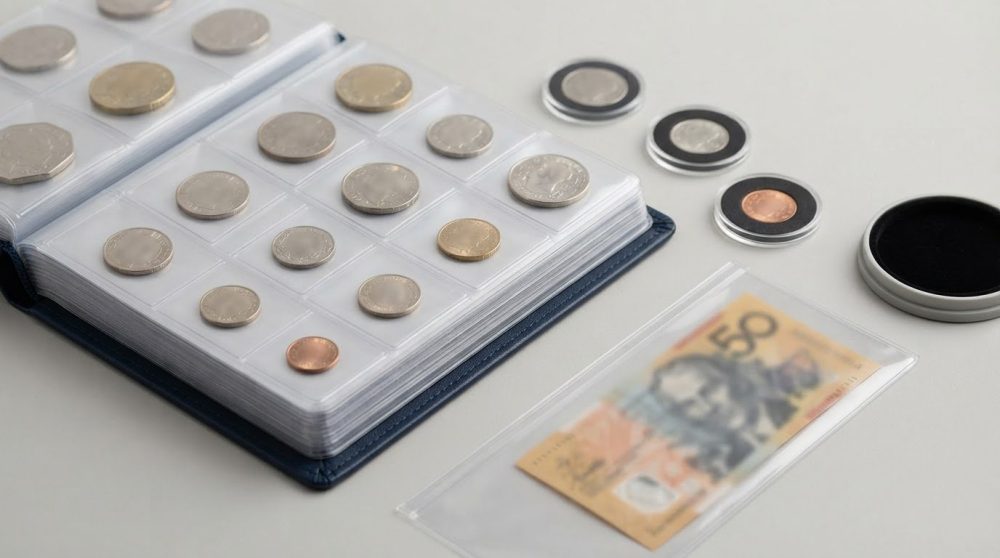
Match each accessory to the object and how you handle it. A direct-fit coin capsule holds a specific diameter securely, while a universal clamshell suits mixed sizes. Handle raw coins by their edges and store them individually. Coins already sealed in PCGS or NGC holders need no extra capsule. For Australian and British series, choose album pages that match the coin layout before adding pieces.
Material matters as much as format. PVC sleeves can release plasticisers that leave residue or etch coins over time. Choose PVC-free polypropylene or polyester, and keep storage acid-free, flat and out of direct sunlight. Heat and humidity can accelerate toning on silver and copper. Store polymer banknotes in individual sleeves or pocket pages, flat and away from heat, rather than in tightly packed stacks. For choosing an album format and comparing page capacity for banknotes, see this guide to banknote storage albums.
Stamp mounts and examination tools answer different needs. Hingeless mounts avoid the gum marks traditional hinges may leave, and should be acid-free and PVC-free. A 10x magnifier helps inspect coin details or stamp perforations. UV lamps reveal fluorescent features on banknotes and phosphor bands on stamps. These tools assist close examination, but visual checks alone cannot authenticate an item.
Build a practical set around your collection: capsules for selected raw coins, suitable pages for organised series, and a magnifier for close inspection. Store paper money flat rather than folded, particularly in Australia’s warmer conditions. To examine small design features, See an example here of a magnifier category used by collectors.
Renniks: Lighthouse Album Systems
Renniks offers Lighthouse Album Systems for collectors who want a structured way to organise coins by series, date or denomination. Choose page layouts to match the collection before adding pieces, so new entries can be arranged consistently. For individual raw coins, Lighthouse Coin Capsules and 2×2 coin holders provide separate storage options; HAGNER sheets and binders suit collections arranged in pages.
Choose a format that suits how you handle and study your collection. Keep coins in suitable holders, not PVC-based pages or sleeves, which can leave residue or damage surfaces over time. For a growing Australian coin series, an album supports orderly expansion and makes gaps easier to spot. Explore Renniks’ album systems and related coin-storage supplies.
Put a considered storage plan into practice
Renniks offers Lighthouse Album Systems for structured pages, alongside Lighthouse Coin Capsules and 2×2 coin holders for individual coins. Match the format to how you intend to store and access each piece, then build your system gradually as your interest in numismatics develops. A thoughtful setup gives each new addition a clear place in the collection.
Shop the supplies in this guide
Put the advice above into practice with these collecting supplies from Renniks:
- Coin Sheets NUMIS, 2 pockets for banknotes and postcards
- Coin Sheets NUMIS, 3 pockets for banknotes
- Coin Capsules, Inner Diameter 25mm
- ULTRA Coin Capsules, inside Ø 32.5mm
- The John Bertrand New Zealand Coin and Banknote Catalogue 2021
- Hagner 1/2 Page (1 Strip) – Black (Pack of 100) Banknote holder
Frequently Asked Questions
Did you know?
Australia’s circulating banknotes have been polymer since the bicentennial $10 note issued in 1988, according to the Reserve Bank of Australia. That change gave Australia a distinctive place in banknote history and altered how notes feel and handle. Polymer is not indestructible, though: heat can affect it, so material and condition remain useful details when cataloguing an example.
What is numismatics and what does it include?
Numismatics is the study of monetary objects, including coins, paper money and medals. To explore the subject, record each object’s issuer, denomination, date and purpose, then compare design changes across issues. This approach connects an Australian coin with its historical context without limiting a collection to one denomination or period.
Which Australian coins are rare and valuable?
No single list identifies every rare Australian coin. Start by checking the date and mint mark, then inspect the design for a possible die variety or production error. A magnifier can help reveal small differences, but an unusual feature alone does not establish rarity. Record what you observe and compare it with a reference for that exact issue.
How much are Australian collectible coins worth?
Identify the exact issue and condition, then compare it with the matching entry in a current Australian coin reference. Check that the denomination, date and mint mark align, and note whether the reference describes a circulated or uncirculated example. For a useful research record, write down the source and edition rather than relying on an isolated online asking price.
What are the best ways to store and protect a coin collection?
Organise coins using a clear system, such as denomination, date or mint mark, and create a catalogue record for each entry. Use a correctly sized capsule for a raw coin; a graded coin already sealed in a PCGS or NGC holder needs no additional capsule. Label album pages consistently, and check older holders for clouding, residue or looseness.
Disclaimer
This article is provided for general information and collecting guidance only, and is not financial or investment advice. Coins, stamps, banknotes and trading cards can fluctuate in value, and nothing here should be read as a guarantee that any item will increase in value. Any value mentioned reflects a reference-guide estimate at the time of writing, not a current market valuation; always check the latest edition of Renniks Australian Coin & Banknote Values or an independent source for current figures. Renniks does not grade, authenticate or appraise items; grading opinions belong to independent third-party services such as PCGS and NGC. Links to external websites are provided for reference only; Renniks is not responsible for the content of third-party sites.
