





Coins
How to Catalogue Coins and Keep Your Collection Organised
Oct
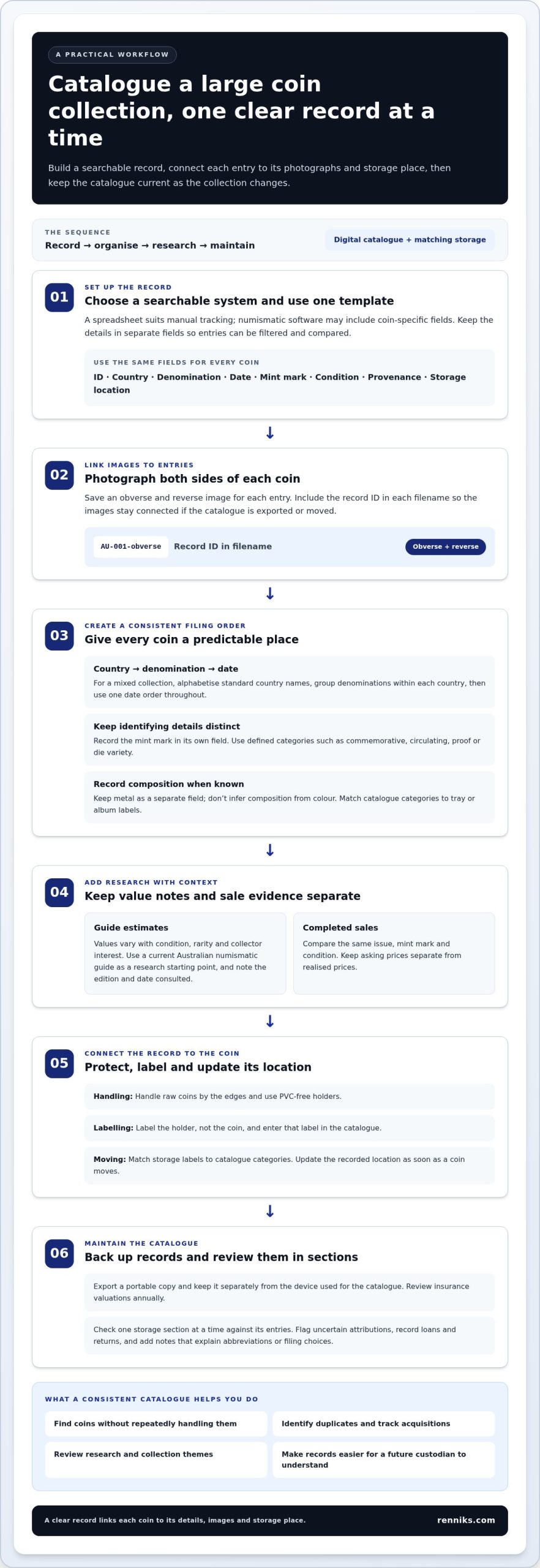
A coin collection is easier to manage when every piece has a consistent record and a known storage location. To catalogue a large coin collection, record each coin’s country, denomination, date, mint mark, condition, provenance and location, then add clear images of both sides. This creates a practical reference for identifying duplicates, tracking acquisitions and finding a coin without repeatedly handling it.
A catalogue also preserves details that can be difficult to recall later, such as a coin’s origin or why you set aside a particular variety. Choose a digital system that lets you search and update entries, and use the same fields for every coin so records stay consistent as the catalogue grows. The steps below explain how to define those fields, organise entries and use the catalogue to manage your collection.
Key Takeaways
- Choose a digital catalogue with searchable fields, then record each coin’s identifying details and storage location consistently.
- Group entries by a clear system, such as country, denomination, date or mint mark, so you can locate and compare coins easily.
- Record acquisition details and photographs to retain provenance and make the collection easier to review as it grows.
- Match your physical storage to the collection: Lighthouse Album Systems, coin capsules and 2×2 coin holders can help keep catalogue entries connected to their coins.
Coin cataloguing software and digital platforms
To catalogue a large coin collection efficiently, choose a searchable digital system and use one record format throughout. A spreadsheet works well for manual tracking, while numismatic software may include fields designed for coin records. Keep an independent backup.
- Configure your record template. Include an ID, country, denomination, date, mint mark, condition, provenance and storage location. Use separate fields for each detail so you can filter Australian coins by denomination or compare dates without searching free-text notes.
- Attach photographs. Save two images per coin, showing the obverse and reverse. Use the record ID in each filename, such as “AU-001-obverse”, so photographs remain connected if you export or move the catalogue.
- Keep value notes in context. Australian coin values vary with condition, rarity and collector interest. Use a current Australian numismatic guide as a research starting point, and label estimates with the guide edition and date consulted.
- Review auction evidence carefully. Compare completed sales for the same issue, mint mark and condition. An asking price is not a realised price, so keep those figures separate in your notes.
- Protect coins while recording them. Handle raw coins by the edges and use PVC-free holders; PVC can leave residue or damage surfaces. Label the holder rather than writing on the coin, and enter that label in its record.
- Export and back up records. Save a portable copy of your catalogue separately from the device you use. Review insurance valuations annually. For GST purposes, the Australian Taxation Office does not consider gold, silver or platinum coins of numismatic quality to be in an investment form.
Alphabetical, numerical, and categorical organisation
Choose a primary filing order and use it consistently in both your catalogue and physical storage. For a mixed collection, sorting by country, then denomination and date, gives every coin a predictable place.
- Index by country. Use standard country names and keep them alphabetised. Store “Australia” under A rather than switching between “Australian” and “Australia” across entries.
- Arrange denominations within each country. Keep pennies, shillings and decimal denominations in separate groups. This makes comparisons within a series easier and stops unrelated issues sharing the same date sequence.
- Apply one date order. Sort from earliest to latest, or latest to earliest, and use that order throughout. Keep the mint mark in its own field, since coins from one year may differ by mint.
- Use categories for distinct collecting interests. Labels such as “commemorative”, “circulating”, “proof” and “die variety” can distinguish collecting groups. Define categories in your notes and avoid using several labels for the same feature.
- Record metal separately. Add the coin’s composition as a field when known, and group silver separately from non-silver pieces for physical storage. Don’t infer composition from colour, which can be affected by wear or toning.
- Connect the filing system to storage. Mark trays or album sections with matching country and denomination labels. If a coin moves, update its location in the catalogue immediately, rather than relying on its former position.
Keep the arrangement flexible. Add a category when a distinct group takes shape, then update the index and storage labels to match.
Benefits of keeping a coin collection catalogue
A well-maintained catalogue helps with more than finding a coin. It gives you a working record of how the collection is organised, what you have researched and which pieces need attention.
- Reduce unnecessary handling. Use the recorded storage location to retrieve a coin for comparison or study. This is useful when a particular piece sits among similar issues and repeated inspection would otherwise mean opening several holders.
- Make research more systematic. Flag entries with uncertain attributions, then investigate those records together. For Australian issues, consistent terminology from a coin and banknote reference catalogue can help keep descriptions clear across the collection.
- Record changes in custody. If coins are lent for an exhibition, study session or family viewing, note which pieces left storage and when they returned. This creates a simple movement history and helps reconcile the physical collection after handling.
- Make collection knowledge transferable. Add brief notes explaining unusual abbreviations, filing choices or research references. A family member or future custodian can then understand why a coin is grouped in a particular way, rather than needing to reconstruct the system from scratch.
- Direct future collecting. Review catalogue notes to identify themes that interest you, such as commemorative issues, particular monarchs or a series of designs. Use those interests to guide research and collecting priorities without relying on memory alone.
- Improve routine checks. Compare catalogue entries with the contents of one storage section at a time. This can reveal a misplaced coin or an outdated location record before it causes confusion elsewhere.
Renniks: Lighthouse Album Systems
Renniks offers Lighthouse Album Systems for collectors who want their physical storage to match their catalogue. Align album sections with your recorded categories, such as country, denomination and date, so each entry points to a clear location.
For individual raw coins, Lighthouse Coin Capsules and 2×2 coin holders provide different ways to house pieces alongside your records. Choose a holder that suits the coin and your storage arrangement, then keep its location label consistent in the catalogue. This makes a digital entry useful at the album or storage box, not only on screen.
As your collection grows, review whether your album layout still suits the way you search for and compare coins. Explore storage options for your catalogue at renniks.com.
Make your catalogue work for the collection ahead
Knowing how to catalogue a large coin collection also means allowing for change. When you add new pieces, check that your categories and storage locations still make sense, and update the catalogue whenever you move or regroup coins. Consistent records remain useful as your collecting interests develop.
When you refine the physical system, consider how Lighthouse Album Systems, Lighthouse Coin Capsules and 2×2 coin holders fit the way you access and store individual pieces. The right arrangement is the one that keeps each coin’s record connected to its location without adding unnecessary handling.
For a considered next step, explore Renniks’ collecting resources and storage options.
Shop the supplies in this guide
Put the advice above into practice with these collecting supplies from Renniks:
- Coin Sheets NUMIS, 20 pockets up to 34mm Ø
- Coin Sheets NUMIS, Mixed with 1 pocket each NUMIS 44, 34, 25, 17, MIX
- Coin Sheets NUMIS, for 12 coin Holders (50x50mm)
- The John Bertrand New Zealand Coin and Banknote Catalogue 2021
- Renniks Australian Coin & Banknote Values 33rd Edition, Softcover
- Coin Wallet with 10 Coin Sheets each for 6 cardboard holders, blue
Frequently Asked Questions
How to catalogue coins?
Start with a small, clearly defined group, such as one denomination from one country. Give each coin a unique catalogue ID, and use the same identifier on its physical holder and digital entry. This links the record to the coin, even if you later change your filing system.
What information should be recorded for each coin in a catalogue?
Record enough detail to distinguish each coin from similar issues: country, denomination, date, mint mark, metal, edge type and notable design features. Add an identification number, acquisition details and a concise condition description. If a date or mint mark is unreadable, record it as unclear instead of guessing.
How can I identify a coin’s country, denomination, date, mint mark and variety?
Start by reading the legends and denomination, then compare the design with a suitable reference for that country and issue. Check both faces and the edge, as identifying marks can appear in different places. A die variety is a design difference linked to a particular die. Before recording one as confirmed, distinguish it from damage or wear.
How should coins be graded and photographed for a catalogue?
Describe visible wear and marks consistently, and avoid cleaning a coin before assessing it. For a personal catalogue, write a clear condition note rather than presenting an informal estimate as a professional grade. PCGS and NGC provide independent grading services, and their numerical grades apply to coins they assess. Photograph each coin under even lighting, holding the camera steady.
How can I catalogue a large coin collection efficiently in batches?
Process one container or clearly separated group at a time, completing its records before moving on. Assign IDs in sequence, keep unrecorded coins apart from those already catalogued, and reconcile each group with its storage location. Set aside uncertain identifications for later research so they do not slow progress on straightforward entries.
Disclaimer
This article is provided for general information and collecting guidance only, and is not financial or investment advice. Coins, stamps, banknotes and trading cards can fluctuate in value, and nothing here should be read as a guarantee that any item will increase in value. Any value mentioned reflects a reference-guide estimate at the time of writing, not a current market valuation; always check the latest edition of Renniks Australian Coin & Banknote Values or an independent source for current figures. Renniks does not grade, authenticate or appraise items; grading opinions belong to independent third-party services such as PCGS and NGC. Links to external websites are provided for reference only; Renniks is not responsible for the content of third-party sites.
