




Coins
Rare Australian Coins: What Makes Pennies and the Mule Dollar Valuable
Oct
A coin’s age alone doesn’t make it rare. Rare Australian coins are valued for a combination of scarcity, condition and collector demand: the 1930 penny has about 1,500 circulated examples, while the 2000 mule dollar is known for a minting error involving a 10-cent die. Proof coins are another category, made with a special finish for collectors.
Collectors often focus on the details that distinguish one example from another, including wear, surface quality and evidence of an error. This article explains what affects a coin’s rarity and value, then looks more closely at the 2000 mule dollar, Australian pennies and proof coins. These features provide a practical starting point for understanding why some coins attract sustained interest.
Key Takeaways
- Assess rarity through a coin’s condition, scarcity and collector demand, not its age alone.
- Learn what distinguishes the 2000 mule dollar error and which design details to inspect.
- Compare the features that make 1930 pennies and proof coins notable to collectors.
- Choose a Lighthouse Album System to organise coins while keeping them accessible for inspection.
What Makes an Australian Coin Rare and Valuable?
Rarity depends on how many examples survive, their condition, and collector demand. Date, denomination and mint marks provide the first clues. The 1930 penny, for example, has about 1,500 circulated examples. If you find one, compare its date and design details, then assess wear before considering its value. A scarce date in heavily worn condition differs from a sharply struck, well-preserved example.
Look closely at the obverse and reverse for unusual features, including mint marks, die varieties and minting errors. A die variety is a small design difference caused by a die used to strike coins. The 1813 Dump, described as Australia’s first coin, carries an “H” mark on its reverse, associated with mint master Henshall. Australian silver coins dated before 1946, other than threepences, were fairly rare to see in circulation, according to the Australian Bureau of Statistics.
Production also provides context. The Royal Australian Mint has made 15 billion circulating coins since decimal currency was introduced in Australia in February 1966. Forecast demand from banks determines the number and denomination mix issued each year, so a date alone doesn’t establish scarcity. Historical significance can add collector interest, but preservation remains central: cleaning can alter a coin’s surface and reduce its appeal.
Recent sale prices for rare Australian coins vary by date, variety, condition and demand. A catalogue estimate is not a confirmed sale price. Compare dated transaction records with a current reference catalogue, and note each coin’s grade and authentication details.
2000 Mule dollar minting error
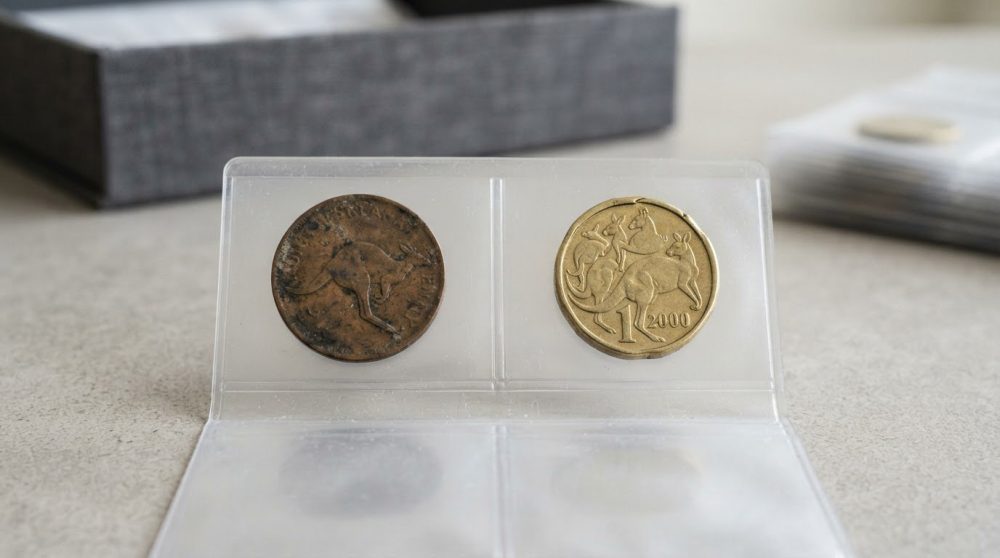
The 2000 mule dollar is a notable Australian minting error involving a 10-cent die. A mule occurs when dies intended for different coin designs are paired, creating a coin that was not an official design variation. Collectors value the error, and examples can attract offers of thousands of Australian dollars.
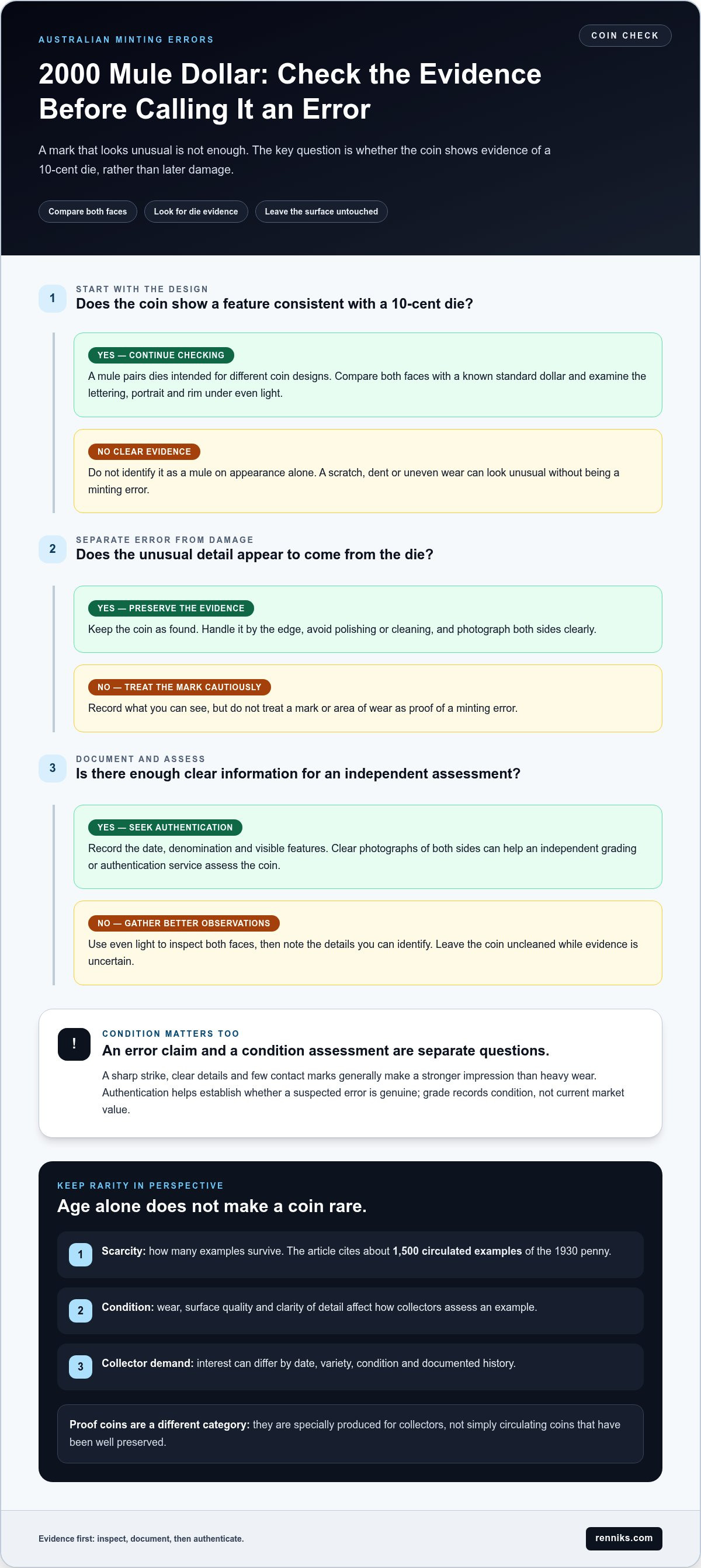
If you find a possible example, inspect both faces under even light before drawing a conclusion. Compare the design details with a known standard dollar and look closely at the lettering, portrait and rim. The key is the evidence of the 10-cent die, not a mark caused by later damage. Scratches, dents or uneven wear can look unusual but do not, by themselves, establish a minting error.
Handle the coin by its edge and do not polish it. Cleaning can leave fine scratches or alter the surface, obscuring details that help assess condition. Record the date, denomination and visible features, then take clear photographs of both sides. This information can help an independent grading or authentication service assess the coin without you altering it.
Condition affects how collectors assess a mule dollar. A sharp strike, clear details and few contact marks generally make a stronger impression than heavy wear. However, authenticate a suspected error before drawing conclusions about its significance. Auction results vary with grade, provenance and buyer demand, so a headline price alone is not a reliable valuation. Keep each sale record linked to the exact coin and its certified grade, if applicable.
Rare Australian pennies and proof coins
The 1930 penny is often regarded as Australia’s rarest penny, and its grade sharply affects collector demand. NGC’s grading records describe one example among the top eight per cent, with only three coins graded higher. These distinctions show why a date alone cannot establish a coin’s standing.
For a potential 1930 penny, first check the date and portrait, then examine the high points for wear. Compare the fields, rims and lettering under good light. Avoid cleaning or polishing, which can leave hairlines and alter the original surface. A professional grade records condition, while authentication assesses whether the coin is genuine. Both matter when assessing a numismatic rarity.
Handle raw coins by the edges and house them in a PVC-free holder; avoid touching either face. Keep copper and silver coins away from heat, humidity and direct sunlight, which can affect their surfaces. For a reference point on Australian dates and grades, consult the Renniks Australian Coin & Banknote Values catalogue. See an example here.
Renniks: Lighthouse Album Systems
Renniks offers Lighthouse Album Systems to organise coins by denomination, date or series. After identifying and grading a coin, place it alongside related pieces and record its details consistently. Choose an album format that suits your collection and leaves room for it to grow.
For individual raw coins, Lighthouse Coin Capsules or 2×2 coin holders provide a separate holding option; choose a size that fits the coin. HAGNER sheets and Binders offer another way to organise material in a binder format. Keep coins handled by their edges and avoid PVC-based holders, which can leave residue or damage surfaces over time.
To organise coins after assessing their dates and condition, explore Renniks’ Lighthouse Album Systems at renniks.com or contact Renniks.
Build a collection you can revisit with confidence
Record each coin’s identifying details, condition observations and grading documentation alongside its place in your collection. Consistent records make comparisons easier when you add coins or review an attribution. For collectors documenting rare Australian coins, a well-organised album and suitable individual holders make the collection easier to review.
Renniks offers Lighthouse Album Systems for organising a series, Lighthouse Coin Capsules for individual coins, and 2×2 coin holders as another storage format. Choose the arrangement that suits the coins you hold and how you want to examine them. A considered record and a suitable place for each coin are sound foundations for the next stage of your collecting.
Shop the supplies in this guide
Put the advice above into practice with these collecting supplies from Renniks:
- Volterra Uno – Coin box for 30 gold coins “Australian Kangaroo” in capsules
- Presentation case for 20 Australian Kangaroo silver coins (1 oz.) in capsules
- Ultra coin capsules Perfect Fit for Australian $2 coin
- Renniks Australian Pre-Decimal & Decimal Coin Errors
- Renniks Australian Coin & Banknote Values 33rd Edition, Softcover
Frequently Asked Questions
What’s Your Coin Worth?
A coin’s value depends on its exact issue, grade, authenticity and current collector interest. Use a current Australian reference catalogue to estimate its value, then compare that estimate with documented sales of coins matching its date, variety and grade. An asking price does not prove a sale, and a catalogue estimate is neither an appraisal nor a guaranteed selling price.
Why Are Some Aussie Coins Worth More Than Others?
Collector demand varies, even between coins of similar age or metal content. A coin may attract interest because it completes a date run, has a documented connection to an event or survives in unusually good condition. Clear provenance and recognised grading can help collectors assess a coin, but interest changes and cannot guarantee a particular outcome.
How can I identify rare Australian coins by date, mint mark, and variety?
Start by recording the date and denomination, then inspect both faces and the edge under consistent light. Use a 10x loupe to examine small marks and design details. Compare those features with a reliable Australian coin reference, paying attention to the location and shape of any mint mark. A claimed variety should show a repeatable die feature, not simply a scratch or dent.
Which Australian coin errors and misprints are valuable?
Recognised minting errors can draw collector interest, including an off-centre strike such as the Australian 1921 halfpenny mistrike. Examine whether the irregularity affects the original strike or appears to result from later damage. A scrape, bend or tool mark acquired after minting is not a mint error. A clear image of both sides and the edge helps document the feature for assessment.
How can I tell whether an Australian coin is authentic?
Compare the coin’s design, lettering and edge with a trusted reference, and look for signs of alteration or casting. Visual inspection alone cannot establish authenticity. PCGS and NGC offer independent authentication and grading, and seal certified coins in tamper-evident holders. Keep any previous documentation with the coin, as its recorded history can help explain its ownership and examination.
Disclaimer
This article is provided for general information and collecting guidance only, and is not financial or investment advice. Coins, stamps, banknotes and trading cards can fluctuate in value, and nothing here should be read as a guarantee that any item will increase in value. Any value mentioned reflects a reference-guide estimate at the time of writing, not a current market valuation; always check the latest edition of Renniks Australian Coin & Banknote Values or an independent source for current figures. Renniks does not grade, authenticate or appraise items; grading opinions belong to independent third-party services such as PCGS and NGC. Links to external websites are provided for reference only; Renniks is not responsible for the content of third-party sites.
