





Coins
Australian Ten Cent Coin: Value, Design and Currency History
Oct
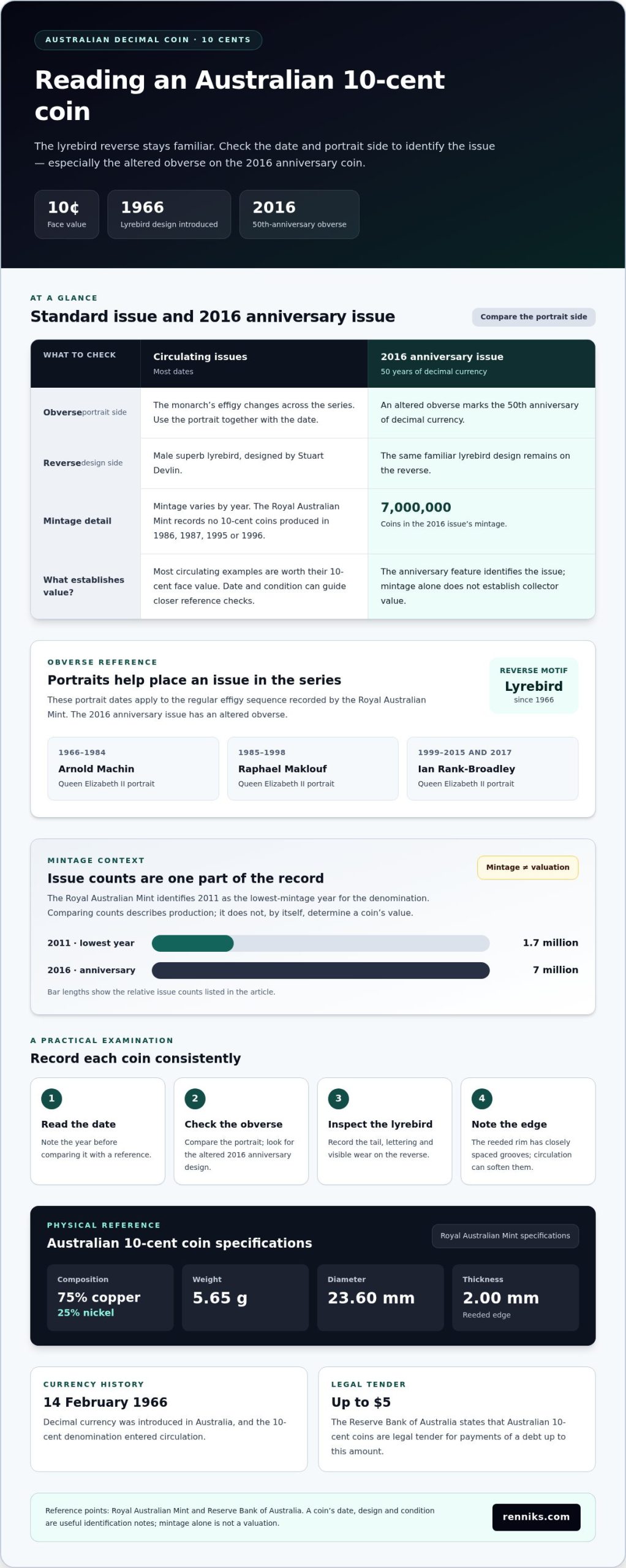
Most circulating Australian ten-cent pieces are worth 10 cents at face value; the 2016 issue is distinguished by an altered obverse for the 50th anniversary of decimal currency. A date or commemorative feature alone doesn’t establish a coin’s collector value, so assess the specific issue alongside its condition.
This guide sets out how to examine the coin systematically: identify the lyrebird reverse, compare obverse portraits, and record the date and any visible design features. It also explains the denomination’s place in Australia’s decimal currency and how to organise examples for reference. These points help separate an ordinary circulated piece from an issue that warrants closer study, without treating mintage or appearance alone as a valuation.
Key Takeaways
- Most circulating examples are worth their face value of 10 cents; date and condition help guide closer reference checks.
- The reverse’s male superb lyrebird design dates to 1966, while portraits on the obverse changed over time.
- The 2016 issue is distinguished by an altered obverse for the 50th anniversary of decimal currency.
- Use an album system, coin capsules or 2×2 holders to organise examples according to how you collect and handle them.
The lyrebird reverse design
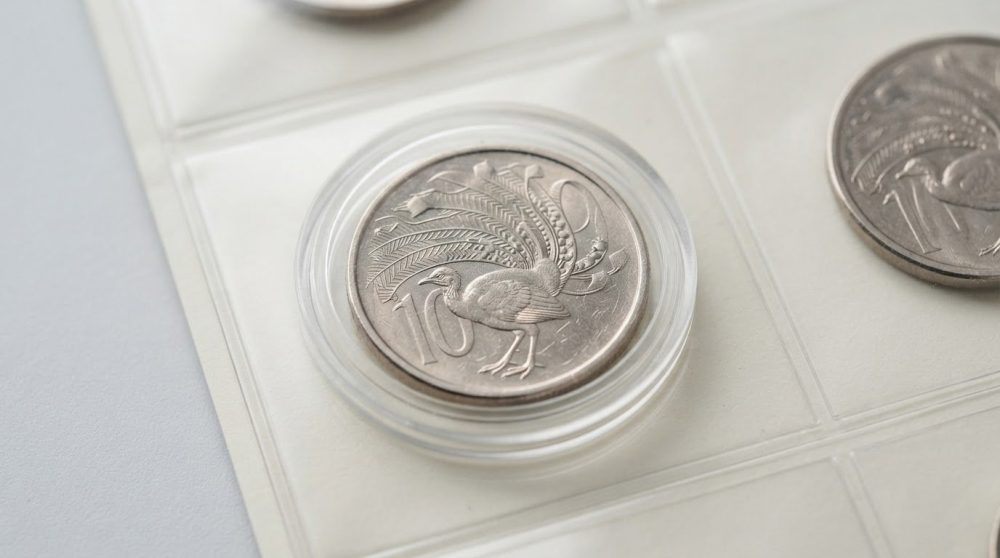
The reverse is the side opposite the portrait, carrying the coin’s main design. The Australian ten-cent coin shows a male superb lyrebird, an Australian songbird. According to the Royal Australian Mint, Stuart Devlin designed the motif, which has appeared since decimal currency began in 1966. Its distinctive tail feathers give the reverse its identifying detail. The design has remained largely unchanged, making the date and condition useful points to record when comparing examples.
The obverse is the portrait side of a coin. An effigy is an official portrait of a monarch; successive effigies mark changes to the series. The Royal Australian Mint records Queen Elizabeth II portraits by Arnold Machin from 1966 to 1984, Raphael Maklouf from 1985 to 1998, and Ian Rank-Broadley from 1999 to 2015 and in 2017. These changes affect the obverse, not the lyrebird reverse.
Mint origin does not always create a visible design difference. The Royal Australian Mint notes that ten-cent coins were produced in Canberra and at the Royal Mint in Llantrisant, Wales, in 1981, but their design markings do not distinguish the two issues. For a collection record, note the date, portrait, reverse detail and edge condition. A worn feature alone does not establish a die variety.
Face value and currency history
Decimal currency divides the main unit into one hundred smaller units. Stuart Devlin designed Australia’s decimal coins, including the ten-cent denomination. The Royal Australian Mint’s mintage records show that in 1966, 30 million ten-cent coins were produced at the British Royal Mint and 11 million at the Royal Australian Mint in Canberra. No ten-cent coins were produced in 1986 or 1987, or in 1995 or 1996.
A coin set is a group assembled by year, denomination or issue. A complete date run helps collectors compare production years, but set membership alone does not determine value. The Royal Australian Mint’s mintage information identifies 2011 as the lowest mintage year for this denomination, with 1.7 million coins issued. Mintage is one factor to consider, not a standalone valuation.
2016 Australian 10-cent coin
The 2016 issue is a ten-cent coin with an altered obverse commemorating 50 years of decimal currency. Its mintage was 7,000,000 coins, and the reverse carries the familiar lyrebird design.
Comparisons with other Australian coins
A commemorative issue is a coin with a design change marking an event or anniversary. Compared with other Australian decimal coins, the 2016 ten-cent piece stands out for its anniversary obverse, rather than a new denomination or a different reverse. The Royal Australian Mint’s 50th-anniversary issue retained the lyrebird motif, so collectors can distinguish it by examining the portrait side. The key comparison is therefore the obverse treatment, not the denomination.
Year, mint mark and variety identification
Coin identification uses the date, mint mark and any repeatable design difference to describe an issue. Read the date on the coin, then compare both faces with a reliable reference. A mint mark identifies a mint, but the 1981 ten-cent issues from Canberra and the Royal Mint in Llantrisant cannot be distinguished by design markings. A die variety is a repeatable difference caused by a particular die; check a suspected feature against clear examples before recording it as a variety.
For a 2016 example, look for the anniversary obverse and record the coin’s condition separately from its type. The mintage of 7,000,000 helps describe the issue, but does not alone establish a collector value. Wear, marks and the sharpness of the design all affect how an individual coin compares with another example of the same year.
Renniks: Premium Album Systems
Renniks offers quality album systems for collectors organising Australian decimal coins by denomination, year or design. A dedicated album makes it easier to track gaps in a date run and compare obverse portraits, while keeping coins orderly for reference.
Visit renniks.com to explore premium album systems and choose a practical way to organise your coin collection.
Build a clear record of your collection
Renniks offers Lighthouse Album Systems for arranging a date run, Lighthouse Coin Capsules for individual coins, and 2×2 coin holders for labelled storage. These options support different collecting habits, from an organised album to separately documented examples.
Shop the supplies in this guide
Put the advice above into practice with these collecting supplies from Renniks:
- Renniks Australian Coin & Banknote Values 33rd Edition, Softcover
- Renniks Australian Coin & Banknote Values 31st Ed. Softcover
- Renniks Australian & New Zealand Tokens Values
- Coin Capsules, Inner Diameter 29mm suits Australian 20c + Florin
- ULTRA Coin Capsules, inside Ø 29mm suits Australian 20c + Florin
Frequently Asked Questions
What does the Australian 10 cent coin look like, and what are its dimensions and weight?
It is a round coin with a reeded edge, measuring 23.60 millimetres across and weighing 5.65 grams. Those measurements describe the standard piece, but they don’t establish its date or condition. For a collection record, note any rim knocks or flattened reeds as well as the visible design wear, since handling can affect these details.
Who is featured on the obverse of Australia’s 10 cent coin?
The obverse shows a monarch’s portrait, and the effigy depends on the issue. Earlier coins feature Queen Elizabeth II in portraits by Arnold Machin, Raphael Maklouf or Ian Rank-Broadley. When sorting a mixed group, compare the portrait profile with the date and record both. A portrait variation helps distinguish issues, but does not establish a coin’s value on its own.
What animal appears on the reverse of the Australian 10 cent coin?
The reverse shows a male superb lyrebird. Stuart Devlin’s design features the bird’s elaborate tail, a clear point of comparison when examining coins. On a well-circulated example, inspect the tail and lettering for flattened detail. Avoid polishing the surface, as cleaning can leave marks and alter the coin’s appearance.
When was the Australian 10 cent coin first issued?
For a collection, use the date as the first sorting field, then group coins by portrait or condition if useful. A chronological arrangement makes it easier to spot missing years without assuming every date represents a different design.
What metals and composition are used in Australian 10 cent coins?
They are made from 75% copper and 25% nickel. This composition is shared across the denomination, so it won’t distinguish one date from another.
Disclaimer
This article is provided for general information and collecting guidance only, and is not financial or investment advice. Coins, stamps, banknotes and trading cards can fluctuate in value, and nothing here should be read as a guarantee that any item will increase in value. Any value mentioned reflects a reference-guide estimate at the time of writing, not a current market valuation; always check the latest edition of Renniks Australian Coin & Banknote Values or an independent source for current figures. Renniks does not grade, authenticate or appraise items; grading opinions belong to independent third-party services such as PCGS and NGC. Links to external websites are provided for reference only; Renniks is not responsible for the content of third-party sites.
