






Coins, Knowledge Base
Lighthouse Coin Capsules: Choosing the Right Fit and Storage Approach
Oct
The right Lighthouse capsule depends on the coin’s measurements and how you plan to store and handle it. This guide explains the role and limits of capsules for raw coins, how to compare capsule formats with your collection needs, and how to organise holders in Australian home conditions.
Contents: What capsules do for raw coins; choosing a capsule format; storing capsules in Australian conditions.
Byline: Renniks editorial team.
Disclaimer: This article provides general collecting and storage information, not coin grading, authentication or financial advice.
Key Takeaways
- Handle raw coins by their edges, and use a capsule to reduce contact with handling oils and abrasion without treating it as a guarantee against damage.
- Before choosing lighthouse coin capsules, identify the coin and measure its diameter and thickness so you can compare them with the stated product dimensions.
- Consider a close direct fit for an individual coin or a looser universal format for mixed holdings, based on how you plan to organise the collection.
- Choose clearly labelled PVC-free storage and keep capsules away from heat, direct sunlight and damp conditions to better suit Australian conditions.
What Lighthouse coin capsules do for raw coins
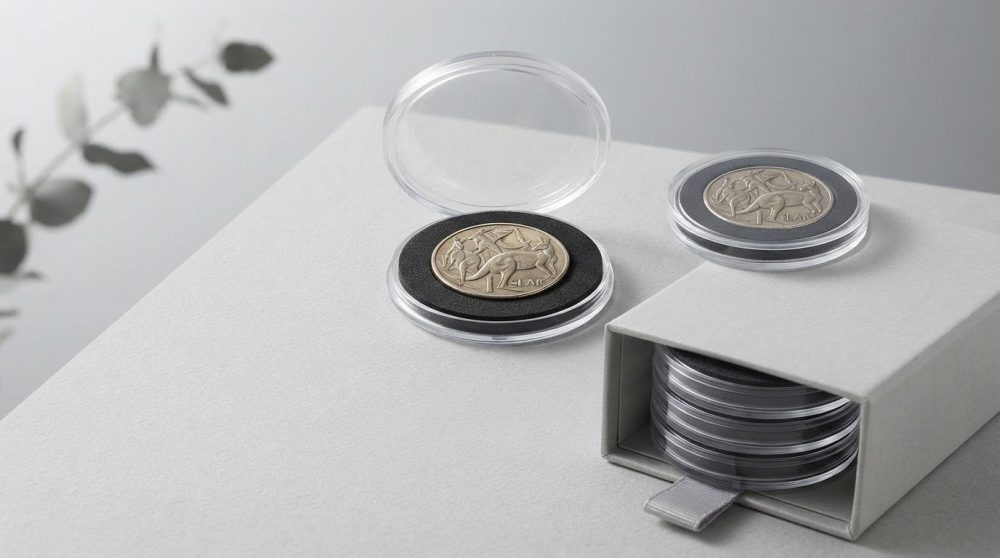
A coin capsule is a rigid holder that encloses a coin, helping limit contact with handling oils, surface abrasion and airborne contaminants. It provides a barrier during ordinary handling and storage, but it can’t guarantee preservation: temperature, humidity, existing surface condition and the way a coin is handled still matter. Handle a raw coin, one that hasn’t been sealed in a third-party grading holder, by its edges, avoiding contact with the obverse and reverse.
Coin collecting involves preserving coins, with their condition being key to their value. That makes the capsule a practical part of careful storage, not a substitute for clean handling or a stable storage environment. Lighthouse coin capsules are one option for enclosing raw coins; the correct fit depends on the coin and the capsule format.
Direct-fit capsules, universal capsules and graded holders
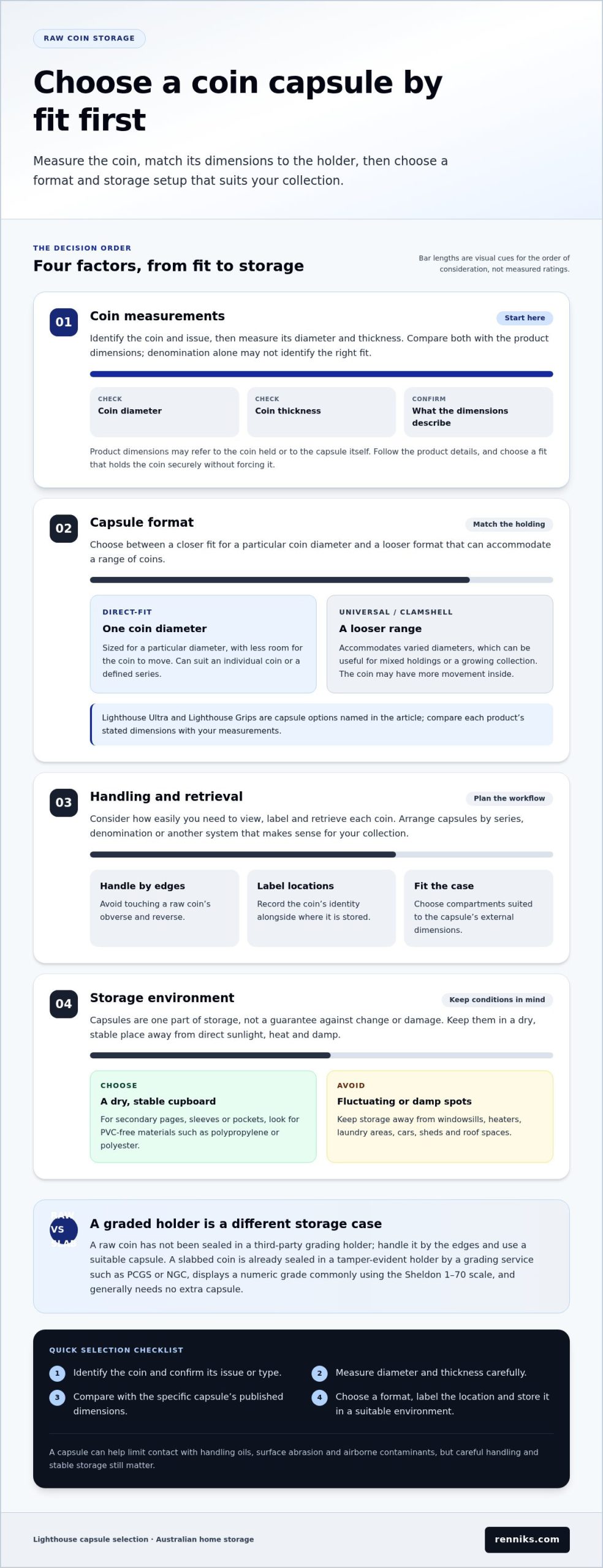
A direct-fit capsule is sized for a particular coin diameter, holding the coin with less room to move. A universal or clamshell format accommodates a looser range, which can be useful for mixed holdings, though the coin may have more movement inside. Compare the coin with the stated capsule dimensions rather than relying on its denomination alone. Renniks’ Lighthouse Ultra coin capsules are one direct-fit option to consider.
A raw coin relies on careful handling and a suitable capsule; a slabbed coin is already sealed in a tamper-evident holder by a third-party grading service. PCGS and NGC holders display a numeric grade, commonly using the Sheldon 1-70 scale. A slabbed coin generally needs no extra capsule. See PCGS grading terminology for an explanation of the scale.
How to choose Lighthouse coin capsules for your collection
Choose by the coin’s actual measurements and how you intend to organise the collection, rather than by denomination alone. A familiar denomination can still be an unreliable guide if you’re selecting for a different issue, a variety or a coin from another country.
- Identify the coin and confirm which issue or type you’re storing.
- Measure its diameter and thickness carefully.
- Compare both measurements with the published dimensions for the specific capsule.
Use an accurate measuring tool and take care not to drag it across the coin’s surfaces. Check whether the product dimensions refer to the coin it holds or the capsule itself, and follow the product details when comparing measurements. A suitable fit should hold the coin securely without forcing it into the holder.
Match the capsule format to the coin and collection
A close direct fit can be practical when you’re storing one coin or a defined series, as each capsule is selected for that coin’s diameter. For mixed holdings, or a collection that’s still growing, a universal format may offer more flexibility, although the fit is looser. Either way, consider how easily you need to view, label and retrieve each piece.
For example, a collector building a set one release at a time may prefer to keep capsule sizes consistent within the set, while someone sorting inherited coins may value a format that accommodates varied diameters. Record the coin’s identity alongside its storage location so it can be found without repeatedly handling the capsule. Lighthouse Ultra coin capsules provide one option to compare against your measurements; Lighthouse Grips coin capsules are another named option in the range.
Store Lighthouse coin capsules with care in Australian conditions
For any secondary storage, choose pages, sleeves or pockets clearly labelled PVC-free, such as polypropylene or polyester. Keep the material information with your collection records so you can identify what surrounds each capsule if you reorganise your storage later.
In an Australian home, choose a dry, stable cupboard away from direct sunlight, windowsills, heaters and damp areas such as laundry spaces. Avoid storing capsules in a car, shed or roof space where conditions can fluctuate. A consistent storage location makes it easier to monitor the collection and keep it accessible.
Keep capsule-stored coins organised and accessible
Arrange capsules by series, denomination or another system that suits your collection, and label their storage locations. This makes individual coins easier to retrieve without repeatedly handling the capsules or disturbing nearby pieces. A case with compartments suited to the capsule’s external dimensions can help keep holders in place.
PVC-free materials and sensible environmental storage are complementary precautions, not guarantees against change or damage. Compare capsule options against your coin measurements, then organise the holders in a suitable case. For example, coin boxes for capsules provide a dedicated format for keeping holders together and accessible.
Put a considered storage plan into practice
Make your next step practical: choose one coin or series, note the capsule format and dimensions that suit it, then decide how you’ll label and arrange the holders. That small trial can help you settle on a consistent approach before extending it across a larger collection. The right Lighthouse coin capsules should fit both the coin and the way you intend to handle, view and retrieve it.
Renniks is an Australian-owned specialist established in 1947. It distributes Lighthouse collecting supplies and publishes Australian numismatic reference guides, bringing practical storage advice together with resources for identifying and documenting Australian coins.
Explore an example of the Lighthouse range and consider which option aligns with your collection’s needs. A measured choice is a sound starting point for organised coin storage.
Shop the supplies in this guide
Put the advice above into practice with these collecting supplies from Renniks:
- ULTRA Coin Capsules, inside Ø 39mm
- INTERCEPT ULTRA Coin Capsules 41mm, pack of 10
- ULTRA Coin Capsules, inside Ø 32mm
- Coin Box 35 compartments for Lighthouse Capsules 29mm, smoke coloured
- ULTRA Coin Capsules, inside Ø 22mm
Frequently Asked Questions
Should I clean a coin before placing it in a capsule?
No. Leave the coin’s surface as it is before encapsulating it. Rubbing, polishing or using a cleaning solution can leave fine scratches, remove original surface material or alter its appearance. If there’s loose dust, don’t wipe it across the coin; handle the piece by its edge and avoid touching the obverse or reverse.
Can a coin capsule prevent toning?
No. A capsule can limit exposure to handling and some environmental contaminants, but it can’t stop toning or reverse changes already occurring on a coin. Silver and copper may continue to react with their surroundings, and the coin’s existing surface condition also matters. Treat a capsule as one storage measure, not a guarantee of an unchanged appearance.
How should I store coin capsules in a warm or humid home?
Choose a cupboard in a regularly occupied room rather than a roof space, garage or laundry, where temperature and humidity can fluctuate. Keep capsules on a stable shelf, away from exterior walls that may become damp, and don’t pack them into a container while it or the capsules are wet. Check the storage area periodically for signs of moisture.
Do coin capsules need a separate storage box?
No, but a suitable box makes a group of capsules easier to catalogue, retrieve and return to its place. Check that the compartments suit the capsule’s external dimensions, not only the coin’s diameter. Avoid forcing capsules into tight spaces or stacking them where they can slide about. A label or simple inventory can help locate a specific issue quickly.
Disclaimer
This article is provided for general information and collecting guidance only, and is not financial or investment advice. Coins, stamps, banknotes and trading cards can fluctuate in value, and nothing here should be read as a guarantee that any item will increase in value. Any value mentioned reflects a reference-guide estimate at the time of writing, not a current market valuation; always check the latest edition of Renniks Australian Coin & Banknote Values or an independent source for current figures. Renniks does not grade, authenticate or appraise items; grading opinions belong to independent third-party services such as PCGS and NGC. Links to external websites are provided for reference only; Renniks is not responsible for the content of third-party sites.
