





Coins, Knowledge Base
Coloured $2 Coins: Australian Designs and a Collector’s Guide
Oct
A coloured centre helps identify a commemorative design, but it doesn’t establish a coin’s rarity, value or authenticity. Australian coloured $2 coins should be identified by comparing their design and issue details with reliable records, then assessed in light of condition and any verified variety.
This guide explains how coloured designs fit into Australian $2 collecting, what details to record when checking a coin, and how to approach claims about errors or collector value. It also covers practical handling and storage, so you can document examples carefully and use sound references when researching them.
Key Takeaways
- Compare a coin’s coloured design and other identifying details with Royal Australian Mint issue information before recording it.
- Colour alone doesn’t establish rarity, value, authenticity or a minting error; assess the coin’s condition and verified variety as well.
- For coloured 2 dollar coins, keep a clear record of the details you can verify and use reliable references to assess collecting interest.
- Handle coins by the edges and choose suitable coin storage to help limit contact with oils, abrasion and unsuitable materials.
What makes Australian coloured $2 coins distinctive?
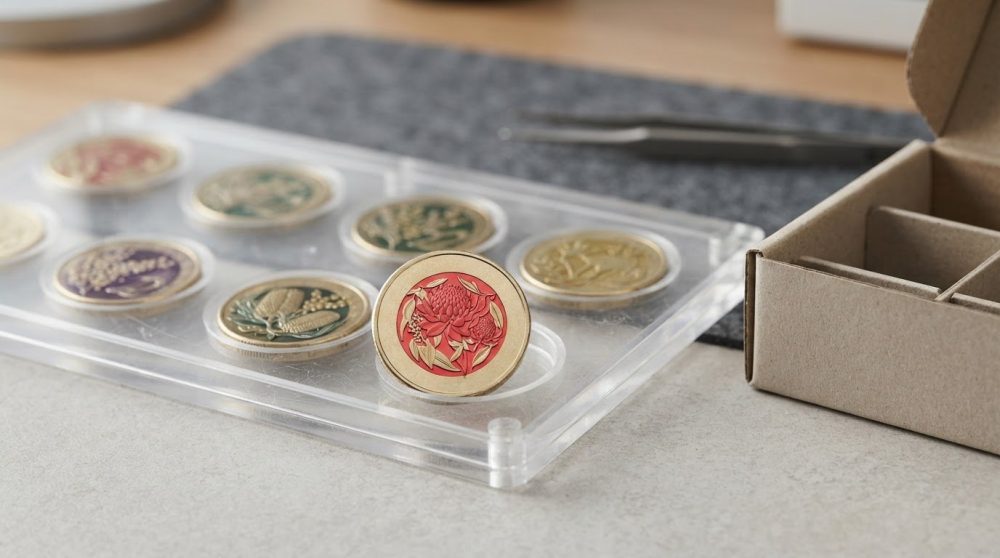
A coloured $2 coin is an Australian two-dollar coin whose design includes a coloured element as part of a commemorative issue. The colour distinguishes part of the design, but doesn’t by itself establish rarity, value, authenticity or a minting error. Collectors use “commemorative” for a coin issued to mark a particular person, event or theme.
Australia’s $2 coin has a broader history of design changes and commemorative issues. The History of the Australian $2 Coin provides background, while Royal Australian Mint issue records are the primary reference for checking official design details and release context.
How coloured designs fit into Australian $2 coin collecting
Coloured issues form one part of a wider denomination collection. The Royal Australian Mint introduced the first coloured circulating $2 coin, the Remembrance Day Red Poppy, in 2012. Later commemorative designs have marked different themes, but their issue arrangements can vary, so don’t assume every coloured coin was distributed in the same way or quantity.
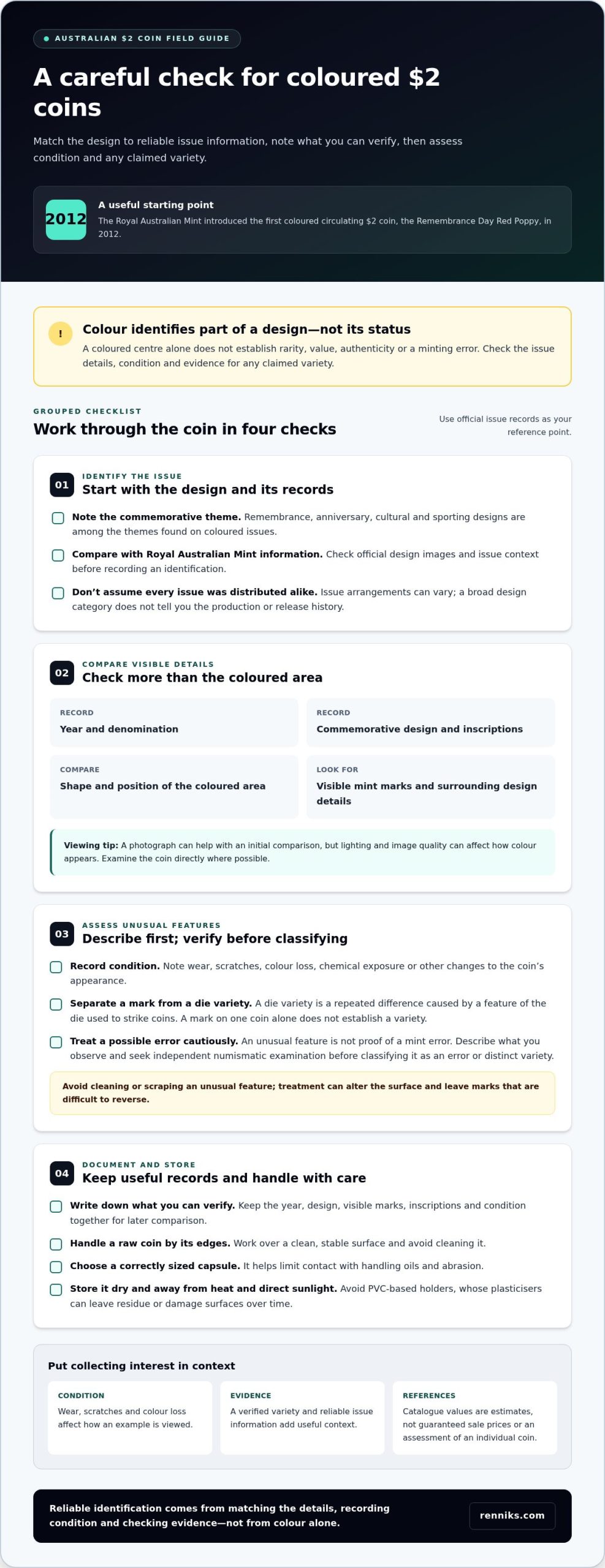
For each coin, record the year, design, inscriptions and any visible mint mark, then compare those details with the relevant Mint issue information. “Coloured 2 dollar coins” is a broad collecting category, not a guarantee that every coin shares the same status or production history.
How to identify coloured $2 coin designs and varieties
Start with the commemorative theme, then compare the coin itself with official issue information. Australian coloured $2 designs include remembrance and anniversary themes, as well as cultural and sporting subjects. These groupings help organise a collection, but they aren’t a complete list of issues and don’t imply that every design had the same release method.
The Royal Australian Mint is the primary reference for official design images and issue context. Compare the coloured area’s shape and position, surrounding details, inscriptions and the coin’s other design elements. A photograph can help with initial comparison, but examine the coin directly where possible, as lighting and image quality can affect how colour appears.
What details to compare on a coloured $2 coin
Record the year, denomination, commemorative design, visible mint marks or other inscriptions, and condition. A die variety is a repeated difference caused by a feature of the die used to strike coins; a mark on one coin alone doesn’t establish a variety. For coloured 2 dollar coins, note precisely where the colour sits and whether its edges and surrounding design match official references.
Wear, scratches, chemical exposure or later colour alteration can change a coin’s appearance. An unusual feature is not proof of a mint error: describe what you observe, avoid cleaning or scraping it, and seek independent numismatic examination before treating it as an error or a distinct variety.
For a further reference when organising Australian issues, consult the Australian coin and banknote catalogue range. Use catalogue information alongside Mint records; neither a visual difference nor a reference entry alone authenticates an individual coin.
What affects a coloured $2 coin’s collecting interest and care?
Collecting interest depends on more than a coloured centre. Condition, a verified variety, collector demand and reliable reference information all contribute to how an example is viewed. Wear, scratches and colour loss can affect condition, while interest in a design can change over time. Colour alone isn’t a guide to rarity or value.
Use catalogue values as reference estimates, not guaranteed sale prices. Any figure should be identified as an estimate from a named, dated edition, such as the current edition of Renniks Australian Coin & Banknote Values. It’s a research aid, not an authentication or appraisal of an individual coin. Background on the history of the Australian two-dollar coin can help place commemorative designs in context, but it doesn’t establish the status or value of a particular example.
Handling, storage and responsible value research
Handle a raw coin by its edges, over a clean, stable surface, and avoid cleaning it. Polishing or chemical treatment can alter the surface and leave marks that are difficult to reverse. Record its condition and verified design details before storing it, so later comparisons don’t rely on memory.
A correctly sized capsule helps limit contact with handling oils and abrasion. Store coins in a dry place away from heat and direct sunlight, and avoid PVC-based holders, whose plasticisers can leave residue or damage surfaces over time. For a dedicated option, browse coin capsules and holders.
Build a well-documented $2 coin collection
Collecting coloured 2 dollar coins starts with matching each design to reliable issue information, then recording its year, visible marks and condition. Colour identifies part of a commemorative design, but it doesn’t establish rarity, authenticity or a minting error. Condition, verified varieties and collector interest provide more useful context.
Use reference values as dated estimates, not guaranteed prices, and handle coins by their edges without cleaning them. Renniks is an Australian-owned specialist serving collectors since 1947, a publisher of Renniks Australian Coin & Banknote Values, and a member of SCDAA, ANDA and APTA. Its catalogue supports research, but it doesn’t authenticate or appraise individual coins.
For a practical next step, explore coin storage options suited to your collection. A careful record and appropriate storage can help you build your collection with confidence.
Shop the supplies in this guide
Put the advice above into practice with these collecting supplies from Renniks:
- Australians Awarded 2nd Edition
- Renniks Australian Coin & Banknote Values 31st Ed. Softcover
- Renniks Australian Pre-Decimal & Decimal Coin Errors
- Coin Box 48 compartments for CAPS 21.5, smoke coloured for $2 coins in capsules
- Ultra coin capsules Perfect Fit for Australian $2 coin
Frequently Asked Questions
Are coloured $2 coins rare?
Colour alone doesn’t establish rarity. First identify the issue and any recognised variety, then check whether the Royal Australian Mint has published relevant mintage information. Assess condition and collector demand as well, since these can affect interest in an example. Avoid assigning a rarity level unless reliable evidence supports it.
How can I tell whether a coloured $2 coin is an official issue?
Compare the coin’s design and issue details with information from the Royal Australian Mint. Check the year, inscriptions and placement of the coloured element against official records or images. Wear, scratches, damage or later colour alteration can make a coin look different. A suspected mint error needs evidence of a production anomaly, not visual difference alone.
Are coloured $2 coins worth more than their face value?
Not automatically. A coloured design doesn’t guarantee a premium; condition, a verified variety and collector demand may all affect interest. If using a catalogue value, treat it as a reference estimate from a named, dated edition, not a fixed price for every coin. Collecting values can change, so don’t treat them as a promise of investment return.
How should I store coloured $2 coins?
Handle coins by the edges and avoid cleaning, which can alter the surface. Store raw examples in a suitable coin holder or capsule, and choose PVC-free materials; plasticisers in PVC can leave residue or damage coin surfaces over time. See coin capsules and holders for dedicated storage options.
Disclaimer
This article is provided for general information and collecting guidance only, and is not financial or investment advice. Coins, stamps, banknotes and trading cards can fluctuate in value, and nothing here should be read as a guarantee that any item will increase in value. Any value mentioned reflects a reference-guide estimate at the time of writing, not a current market valuation; always check the latest edition of Renniks Australian Coin & Banknote Values or an independent source for current figures. Renniks does not grade, authenticate or appraise items; grading opinions belong to independent third-party services such as PCGS and NGC. Links to external websites are provided for reference only; Renniks is not responsible for the content of third-party sites.
