





Coins
Australian 1 Dollar Coin: Origins and Circulation Mintage
Nov
Australia introduced its one-dollar coin on 14 May 1984. Its story brings together the denomination’s role, the changing designs and the production record behind each issue.
For collectors, these details answer different questions. A design identifies what appears on a coin, while its year and issue type provide context. Production totals show how many were made, but must be interpreted alongside the type of issue. Keeping these details distinct makes a collection easier to catalogue and compare.
This guide covers the coin’s origins, explains how annual circulation figures vary and considers what the denomination was intended to do. It also provides context for reading issue details without treating a commemorative design or a low production total as a complete measure of a coin’s significance. Use the sections that follow to understand the records, then apply that framework when organising or documenting your own collection.
Key Takeaways
- The one-dollar coin entered circulation on 14 May 1984, with its familiar five-kangaroo reverse designed by Stuart Devlin.
- Annual mintage figures vary considerably; distinguish coins made for circulation from issues produced only in coin sets.
- Production gaps and commemorative issues help explain why a year’s total may differ from the next.
- Choose an album, capsule or 2×2 holder to suit how you want to organise and store your dollar coins.
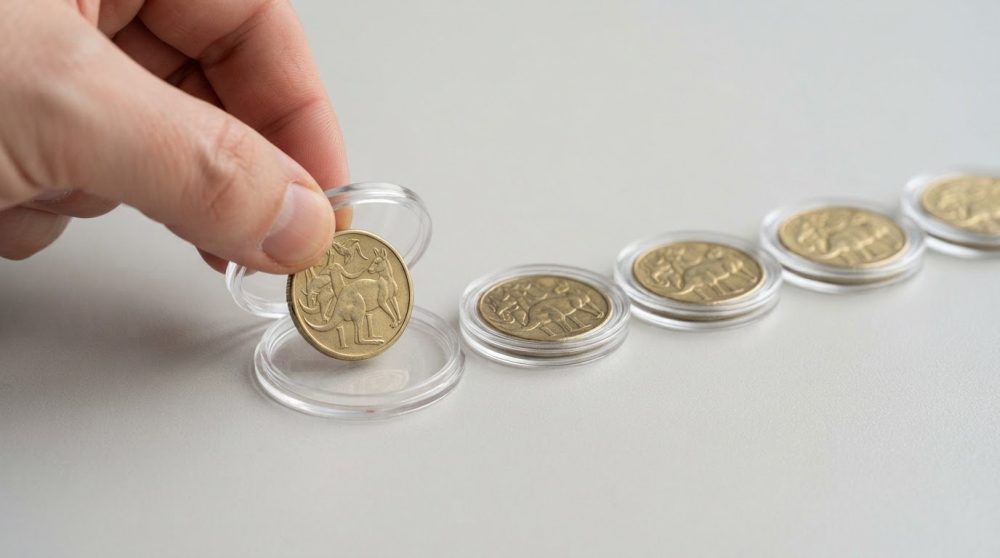
The reverse is the side opposite the monarch’s portrait. According to the Royal Australian Mint, Stuart Devlin designed the five-kangaroo motif in 1983. The denomination entered circulation on 14 May 1984. Collectors commonly call this standard reverse the “Mob of Roos”. Its design provides a useful reference when comparing later issues.
The obverse is the side bearing the monarch’s portrait. The Royal Australian Mint records Arnold Machin’s Queen Elizabeth II portrait on the 1984 issue, followed by Raphael Maklouf’s portrait from 1985 to 1998. Later obverse portraits continued the sequence, helping collectors place individual coins within the series.
A commemorative design marks a subject beyond the standard reverse. The Royal Australian Mint identifies the 2002 Year of the Outback proof as the first dollar proof coin with a coloured reverse. Later examples include the 2010 Centenary of Girl Guiding issue and three Bluey-themed dollar coins issued in 2024. These designs add distinct subjects to the denomination’s record, with character releases often engaging younger family members.
A coin variety is a production difference that distinguishes pieces within an issue. The 2014 colour-printed Mob of Roos dollar struck on a cupro-nickel planchet weighed 10.03 grams. The 2000 mule is another example: the Royal Australian Mint describes the wrong dies producing a heavier obverse rim. Record the year, design and distinguishing feature when cataloguing such pieces.
Circulation coin mintage figures by year
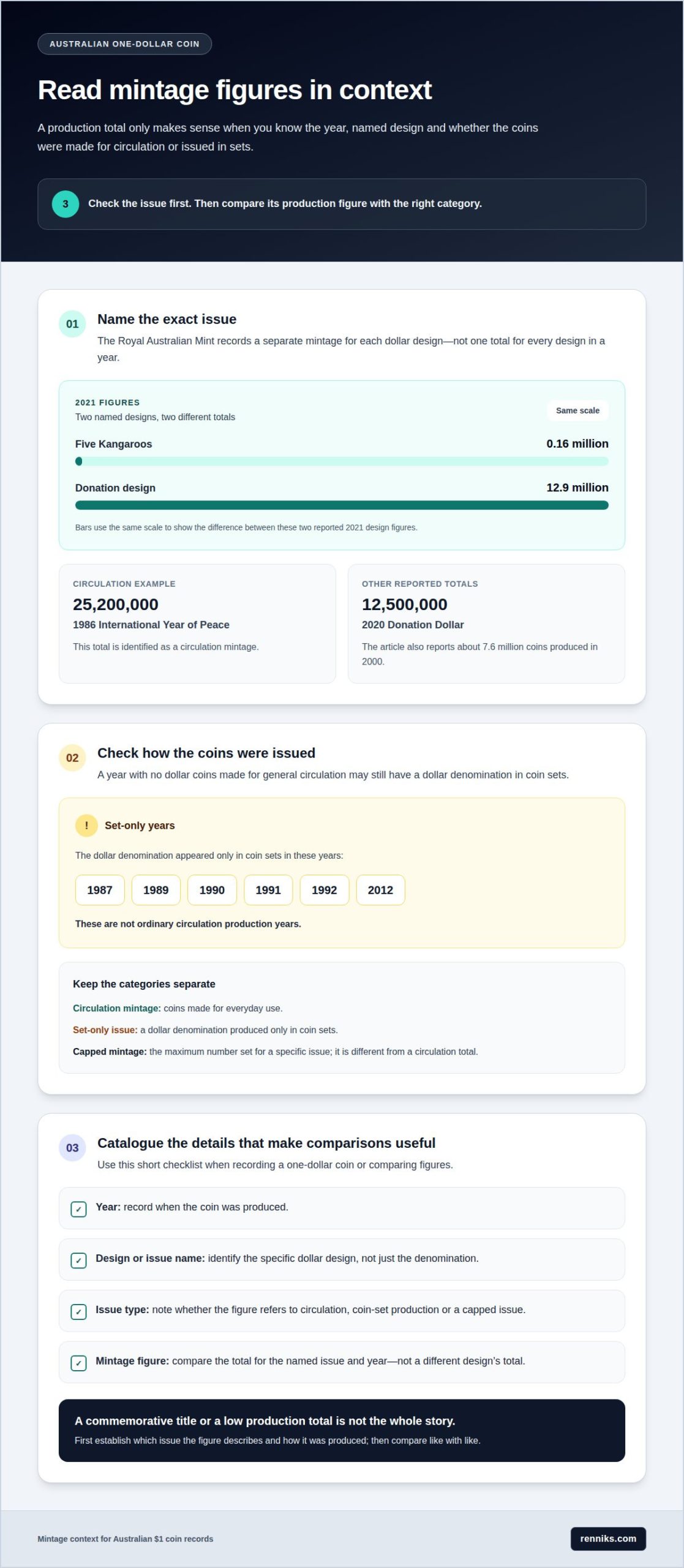
Mintage is the number of coins produced for a particular issue. According to the Royal Australian Mint, each dollar design has its own mintage figure, rather than one total covering every design. For example, its 2021 figures include 0.16 million Five Kangaroos coins and 12.9 million donation-design coins.
Circulation mintage counts coins made for everyday use. Its 1986 International Year of Peace issue totalled 25,200,000 coins.
The Royal Australian Mint’s records distinguish circulation issues from coins produced only in sets. The dollar denomination appeared only in coin sets in 1987, 1989, 1990, 1991, 1992 and 2012. These years therefore should not be read as ordinary circulation production years.
A capped mintage is the maximum number set for a specific issue. It differs from a circulation total. Its 2020 Donation Dollar issue totalled 12,500,000 coins. Production in 2000 was about 7.6 million coins.
Introduction and purpose of the Australian one-dollar coin
The Australian 1 dollar coin serves both as circulating money and as a changing canvas for commemorative designs. Its face value remains distinct from the interest collectors may have in a particular issue.
Coin Purpose
A denomination is a monetary unit with an assigned face value. The Australian 1 dollar coin represents A$1.00 in Australian cash transactions and provides a coin for payments and change. Commemorative reverses can mark subjects such as events or organisations without changing the coin’s monetary denomination. When arranging examples, record the design separately from the face value to keep those details clear.
Legal Tender and Places of Use
Legal tender is money recognised for settling a debt within applicable limits. Australian one-dollar coins are legal tender for payments of a debt up to 10 times the coin’s face value. They may be used in Australian cash transactions where coins are accepted, including purchases and change. The Australian 1 dollar coin’s legal-tender status is separate from its design and mintage; a commemorative reverse does not change the denomination.
Keeping those distinctions in view helps make a collection easier to describe and organise.
Renniks
After reviewing designs and circulation totals, collectors can use Renniks’ products to organise one-dollar issues. Lighthouse Album Systems provide a way to group coins by year or design, while Lighthouse Coin Capsules hold individual coins separately from loose change. Keeping categories distinct makes a collection easier to follow and reference.
For a smaller group of coins, 2×2 coin holders offer another way to keep pieces individually housed. They can suit collectors documenting examples from different years or separating commemorative issues from standard designs. The choice depends on how the collection is arranged and how often its coins are handled.
HAGNER sheets and binders are suited to organising stamps, not coins. For coin-collecting material, choose between albums and individual coin holders according to how you store and handle your collection. Renniks offers these options alongside Lighthouse systems and capsules, supporting different approaches to arranging Australian coin issues.
A clear record distinguishes a coin’s year, design and issue type, especially when comparing circulation production with set-only issues. Renniks’ collecting supplies help keep coins organised for study and display, with mintage categories kept clear. Choose the format that suits your collection and contact Renniks to get started.
Choose a format for your next collecting step
Renniks offers Lighthouse Album Systems for organised display, Lighthouse Coin Capsules for individual coins, and 2×2 coin holders for a compact way to store selected pieces. The right format depends on whether you want to view a sequence in an album or keep particular coins separately. These options give you a practical starting point for maintaining a clear record.
Explore the available collecting supplies and choose a format that fits your approach.
Shop the supplies in this guide
Put the advice above into practice with these collecting supplies from Renniks:
- Renniks Australian & New Zealand Tokens Values
- Renniks Australian Coin & Banknote Values 31st Ed. Softcover
- Australians Awarded 2nd Edition
- ULTRA Coin Capsules, inside Ø 25mm suit Australian $1 coin
- Ultra coin capsules Perfect Fit for Australian $2 coin
Frequently Asked Questions
Australian one-dollar coins are made from an alloy containing copper, aluminium and nickel. The stated composition is 92% copper, 6% aluminium and 2% nickel. These percentages describe the metal proportions, not the coin’s face value or mintage. A commemorative design can change the reverse artwork without changing the denomination represented by the coin.
When was the Australian one-dollar coin introduced?
The Australian one-dollar coin was introduced on 14 May 1984. Planning for the denomination began in the mid-1970s, before the coin entered circulation. The introduction date identifies when the new denomination arrived, rather than when planning started. This distinction helps separate the coin’s development history from the issue dates used to organise a collection.
What are the design and specifications of the Australian $1 coin?
The Australian $1 coin is circular, with five kangaroos on its standard reverse. It measures 25.00 millimetres across and 2.80 millimetres thick. Its interrupted milled edge has 77 notches, each 0.25 millimetres wide. These physical details can help distinguish the denomination when examining a coin’s edge, proportions and design together.
Who appears on the Australian one-dollar coin?
The obverse portrait changes with the monarch’s effigy used for each issue. Queen Elizabeth II appeared on the 1984 coin, with Raphael Maklouf’s portrait used from 1985 to 1998. Later effigies included Ian Rank-Broadley’s portrait from 1999 to 2009 and Jody Clark’s from 2019. King Charles III dollar coins entered circulation in December 2023.
What is the Australian $1 coin made of and how much does it weigh?
An Australian $1 coin has a mass of 9.00 grams. Its alloy comprises 92% copper, 6% aluminium and 2% nickel. The diameter is 25.00 millimetres, and the coin is 2.80 millimetres thick. These measurements provide a useful physical reference alongside the design; they do not determine a coin’s mintage or issue type.
Disclaimer
This article is provided for general information and collecting guidance only, and is not financial or investment advice. Coins, stamps, banknotes and trading cards can fluctuate in value, and nothing here should be read as a guarantee that any item will increase in value. Any value mentioned reflects a reference-guide estimate at the time of writing, not a current market valuation; always check the latest edition of Renniks Australian Coin & Banknote Values or an independent source for current figures. Renniks does not grade, authenticate or appraise items; grading opinions belong to independent third-party services such as PCGS and NGC. Links to external websites are provided for reference only; Renniks is not responsible for the content of third-party sites.
