



Banknotes
How much are banknotes worth? What to check as you start collecting
Nov
A banknote has no single fixed collector value; the Reserve Bank of Australia does not provide opinions on the market value of old, rare or misprinted notes. For anyone learning how to get started in banknote collecting, a useful first step is to choose a focus and understand how condition affects a note’s appeal.
Some collectors begin with Australian notes in circulation; others focus on a period, theme, serial number or signature combination. Choose a subject that gives you a reason to keep learning, rather than treating collecting as a promise of future returns.
This guide explains how to assess condition, spot details that may interest collectors, and store polymer notes flat, away from heat and sunlight. It also covers how collector clubs and online communities can help you share knowledge and develop your collection.
Key Takeaways
- Set a manageable collecting goal, such as following a country, historical period or design theme, then research it before adding notes.
- Compare folds, creases, markings and serial details to understand why two notes from the same issue may attract different interest.
- Use collector clubs and online communities to exchange knowledge, discuss note features and build connections with people who share your collecting focus.
- Choose a banknote storage format that suits your collection, with Lighthouse Album Systems and HAGNER sheets and Binders among Renniks’ options.
1. Choosing a focus for a collection
A clear collecting focus gives each purchase a purpose and makes research more manageable. Start with notes already familiar to you, such as Australian currency, then narrow the scope by denomination, issue, historical period or design theme. A collection of Australian $5 notes, for example, has a more practical boundary than an aim to acquire every banknote ever issued.
Choose a theme you can recognise and explain. Banknotes feature animals, ships, flowers, notable people and regions across different countries. Comparing a theme across issues can reveal changes in illustration, language and national identity. You could instead focus on one country, or collect a particular denomination from countries around the world.
Some collectors start with notes currently in circulation; others seek commemorative, historical or error notes. An inherited group can be a starting point, too. Sort it by country or denomination, then note which pieces prompt further research. This turns an assortment into a clear collecting direction without requiring an immediate commitment to a large series.
Set a boundary before buying. You might collect Australian notes from a particular period or one example of each denomination you choose. The Reserve Bank of Australia’s banknote information is an official reference for Australian issues and their details. Research your chosen area before buying, and use a guide to put examples in context. Remember that estimates are not guaranteed sale prices.
In collector terminology, an uncirculated note has not entered general circulation, but that alone does not determine its grade. Handling, storage and production can leave marks or other condition issues that affect its grade, even if it has no folds or creases. Circulated examples offer another way to study an issue. Choose notes that interest you and fit your budget, then broaden your focus as your knowledge grows.
2. Assessing condition, serial numbers and security features
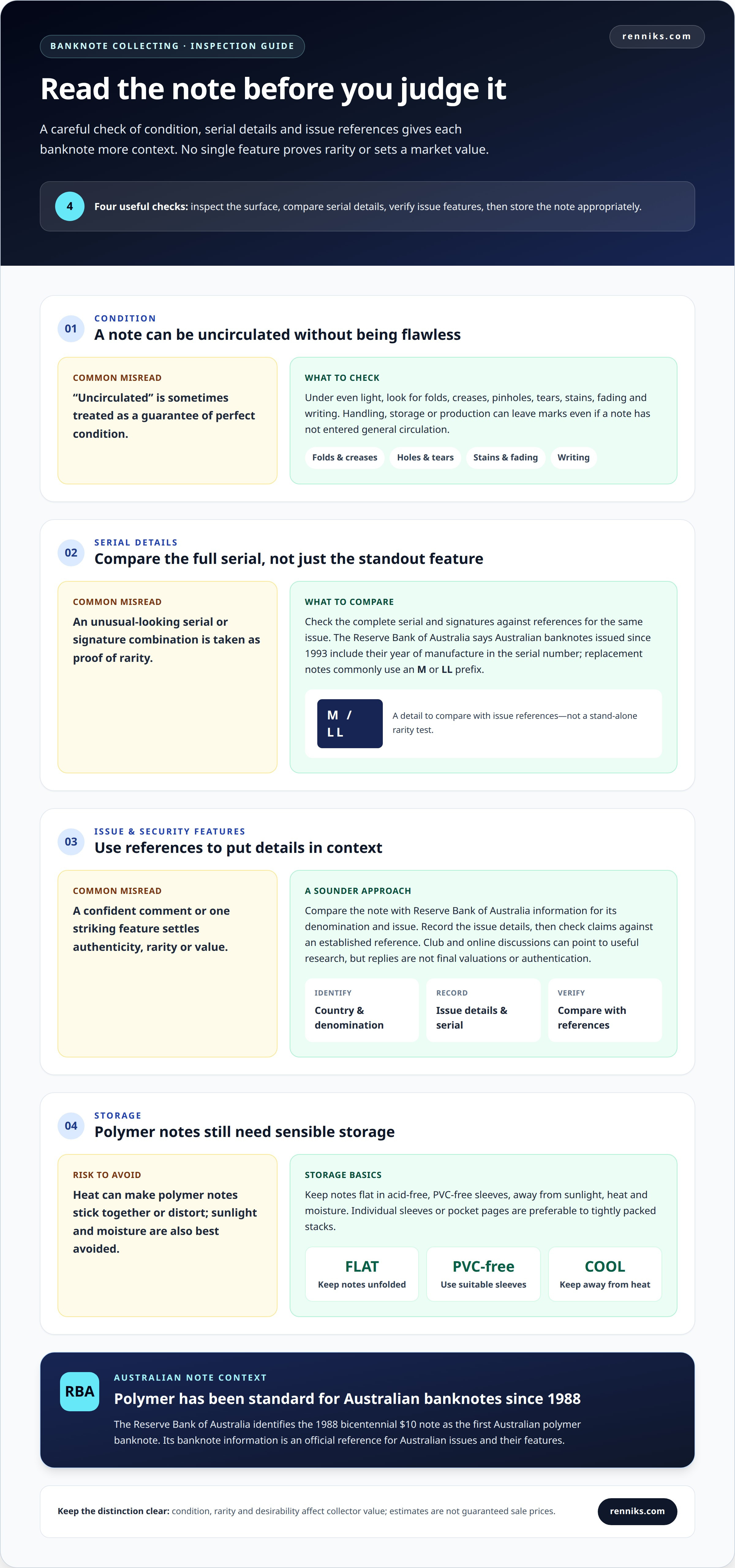
Inspect each note under even light. Check for folds, creases, pinholes, tears, stains, fading and writing. An uncirculated note has not entered circulation, but this describes its circulation status, not necessarily its condition: handling can leave marks, and the note may not be in perfect condition. Condition, rarity and desirability affect collector value, but the Reserve Bank of Australia does not provide opinions on the market value of old, rare or misprinted notes.
Serial details can help distinguish issues. According to the Reserve Bank of Australia, Australian banknotes issued since 1993 include their year of manufacture in the serial number; replacement notes commonly use an M or LL prefix. Compare the full serial and signatures with references for the same issue, rather than treating one unusual feature as proof of rarity.
When buying, selling or owning banknotes in Australia, use clear descriptions and honest transaction terms. Beginners can learn from established collecting organisations, specialist banknote dealers and focused collecting websites. Before committing, compare a listing’s images and description with the note’s issue details.
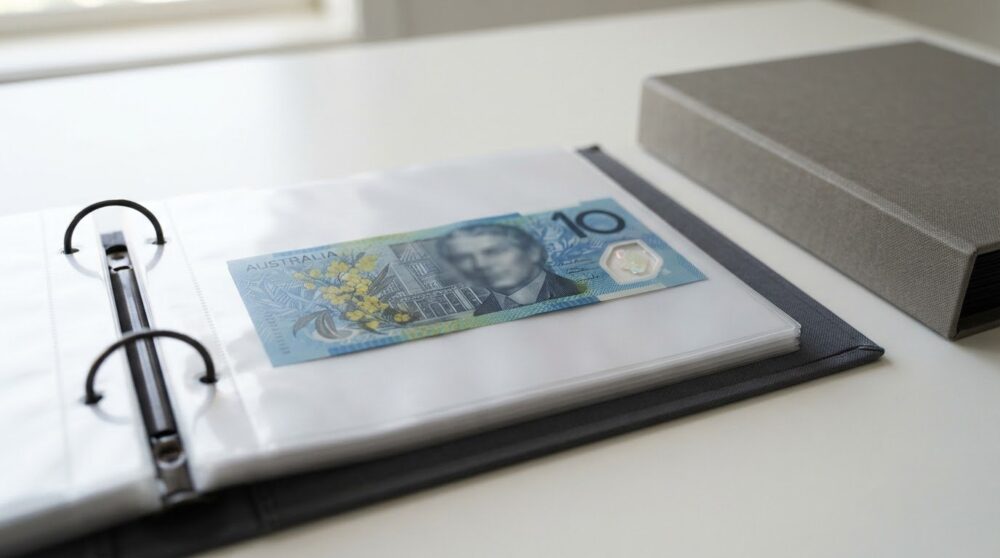
For security features, compare the note with Reserve Bank of Australia information for its issue and denomination. Australian banknotes have been fully polymer since the 1988 bicentennial $10 note, according to the Reserve Bank of Australia. Store notes flat in acid-free, PVC-free sleeves, away from sunlight, heat and moisture. Polymer notes can stick together or distort near heat, so individual sleeves or pocket pages are preferable to tightly packed stacks.
3. Collector clubs and online communities
A local collecting club can turn a banknote collection into a shared study of design and history. At a meeting, members may compare Australian issues, discuss signature changes or bring notes for informal discussion. A display or club talk can also show how collectors organise notes by denomination, year or printer. Attend with one specific question, such as how to distinguish two similar issues.
Online communities make it easier to discuss notes between meetings. In a useful post, identify the country, denomination and visible issue details, and include clear images of both sides. For example, you could ask about a signature combination or unusual serial number on two Australian notes. Keep the question focused so other members can respond to the feature you’re examining.
Treat replies as research leads, not final valuations or authentication. Members may have specialist knowledge, but assessing condition and rarity requires close examination and comparison with reliable references. Before acting on a claim, record the note’s issue details and compare them with an established catalogue. A confident comment alone does not establish that a note is rare or worth a particular amount.
Use club discussions and online archives to build a record of what you learn. Note the terminology, issue distinctions and sources that help explain each example. This makes later comparisons more useful and helps separate a documented feature from speculation.
Renniks
Renniks offers collectors banknote storage and reference materials to support different collecting approaches. Once you’ve chosen a focus, plan how to organise notes by country, denomination or issue, and how to keep them flat and separated.
For a growing collection, banknote storage systems provide formats for arranging and housing notes. A reference catalogue can also help you research Australian issues and compare listed estimates, while remembering that condition and demand affect what collectors may pay.
Contact Renniks if you’d like help choosing storage or reference materials for your banknote collection.
Build a collecting practice that lasts
Keep a useful record as your collection grows. For each note, record where it came from and what caught your attention. Over time, these notes can help you trace how your interests have changed and identify gaps worth researching.
A practical way to learn how to get started in banknote collecting is to treat each addition as a research subject, not simply another item. Keep observations specific, and leave room to revise them as you learn more about an issue or its history. If your interests also include coins, Renniks offers Lighthouse Album Systems, Lighthouse Coin Capsules and 2×2 coin holders for organising and storing those parts of a collection.
A steady record and a clear direction give your collection room to develop with purpose.
Shop the supplies in this guide
Put the advice above into practice with these collecting supplies from Renniks:
- Renniks Banknote Album Plastic Refill Pages, 3 Pockets, Pack 10
- Renniks Banknote Album Plastic Refill Pages, 2 Pockets, Pack 10
- Renniks Banknote Album – Black
- Renniks Australian Coin & Banknote Values 33rd Edition, Softcover
- Renniks Australian Coin & Banknote Values 31st Ed. Softcover
Frequently Asked Questions
How much are banknotes worth?
A banknote’s collector value depends on its issue, condition, rarity and demand, so denomination alone doesn’t determine its market value. Compare it with examples from the same country and issue, paying attention to signatures, serial details and condition. Reference catalogues provide estimates, not guaranteed sale prices. Actual offers can differ with buyer interest and the note’s presentation.
What are uncirculated banknotes?
An uncirculated banknote has not circulated in everyday transactions. The term describes its circulation status; it does not necessarily mean the note is entirely free of handling marks. Look for folds, edge wear, marks and softened corners, which can affect how collectors describe its condition. Storage pressure or careless handling can leave marks even on a note that has never circulated.
What type of banknotes should you collect?
Choose notes that give you a useful research question. Compare portraits across issues from one country, follow a signature combination, or study how a historical event appears in banknote design. A narrow subject makes it easier to assess new additions against what you already own. Record why each note belongs, so your collection develops a clear structure.
How do you start collecting banknotes as a beginner?
To learn how to get started in banknote collecting, begin with a small, defined subject and record each note’s country, denomination, issue details and source. Compare similar notes before broadening your focus, and use reference material to learn collectors’ terminology. A collecting club or focused online discussion can help you investigate details that a photograph alone may not reveal.
What equipment do you need to collect and store banknotes safely?
Start with a suitable album or individual sleeves made from PVC-free, inert material, and keep them in a clean, dry place away from direct light. A magnifier can help you examine fine printed details, while a UV lamp can reveal fluorescent features on some notes. Keep written notes beside the collection rather than attaching adhesive labels to banknotes, which can leave marks or residue.
Disclaimer
This article is provided for general information and collecting guidance only, and is not financial or investment advice. Coins, stamps, banknotes and trading cards can fluctuate in value, and nothing here should be read as a guarantee that any item will increase in value. Any value mentioned reflects a reference-guide estimate at the time of writing, not a current market valuation; always check the latest edition of Renniks Australian Coin & Banknote Values or an independent source for current figures. Renniks does not grade, authenticate or appraise items; grading opinions belong to independent third-party services such as PCGS and NGC. Links to external websites are provided for reference only; Renniks is not responsible for the content of third-party sites.
