




Stamps
First Day Cover Album Guide: Choose the Right Format
Oct
The album with the most pockets isn’t necessarily the right choice for your first day covers. A suitable first day cover album needs to fit the full envelope, make covers easy to view and allow room for your collection to grow.
Capacity and appearance are useful starting points, but page layout and storage materials also matter. This guide compares fixed-page albums with expandable binder-and-page systems, and explains what to assess before choosing a format. You’ll learn to check cover fit, page access and room for future additions, as well as why paper should be acid-free and any plastic pockets or sleeves should be specified as PVC-free. With these details in mind, you can choose an album that suits the covers you collect and keeps them organised for reference.
Key Takeaways
- Choose a first day cover album that accommodates the full envelope, including its stamp and first-day cancellation.
- Compare page layouts by how they display and arrange covers, rather than assuming every page holds the same number.
- Check that pages and binder belong to a compatible system before planning to add covers over time.
- Assess storage materials as well as format, and look for acid-free paper and plastic specified as PVC-free.
What a First Day Cover Album Is, and What It Needs to Hold
A first day cover brings together a stamp and the envelope that carries it, cancelled on the stamp’s first day of issue. The cancellation, usually showing a date and place, connects the cover to that issue; some covers also have a cachet, an illustration or inscription related to the stamp. The First Day Cover overview explains this terminology and the format’s history.
Assess the whole cover, not only the stamp. The envelope, cancellation and any cachet may all contribute to its interest, so a storage choice that focuses only on the stamp can overlook the item you’re collecting. An album gives covers a consistent place and makes them easier to browse or arrange by issue, date or theme. Loose stacking can make particular covers harder to locate and handle; an album supports organisation and access, but doesn’t guarantee preservation.
Start with the covers you actually collect
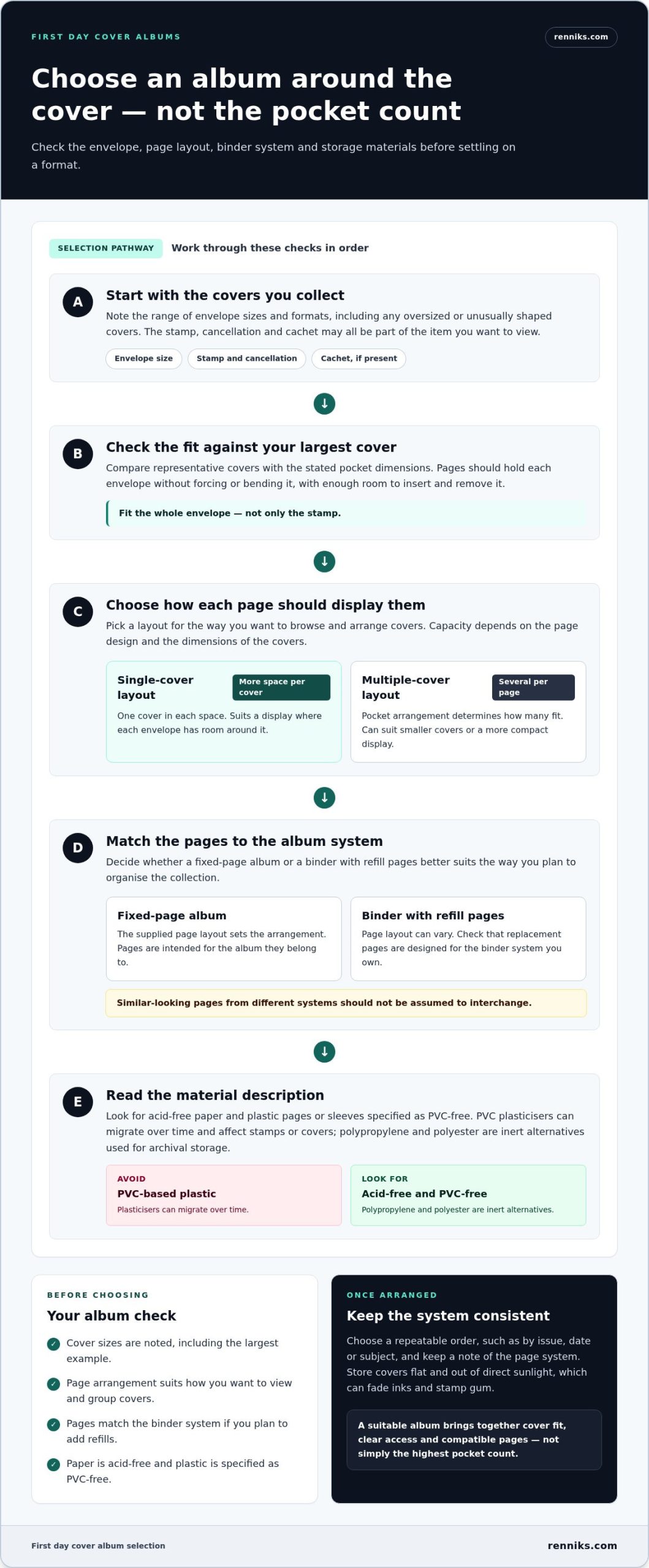
Before comparing albums, note the range of envelope sizes and formats in your collection, including any oversized or unusually shaped covers. Consider whether you want to display single covers with room around each item or group several covers on a page for comparison. A layout suited to individual covers may not suit a denser arrangement, so think about both the largest cover and your preferred way to view the collection.
Pages and pockets should hold the envelope without forcing or bending it. Also consider the storage materials: avoid PVC-based plastic, whose plasticisers can migrate over time, and look for paper described as acid-free and plastic specified as PVC-free. Keep covers flat and out of direct sunlight, which can fade inks and stamp gum. Browse Renniks’ First Day Cover Albums to compare available album options.
How to Compare First Day Cover Album Formats and Pages
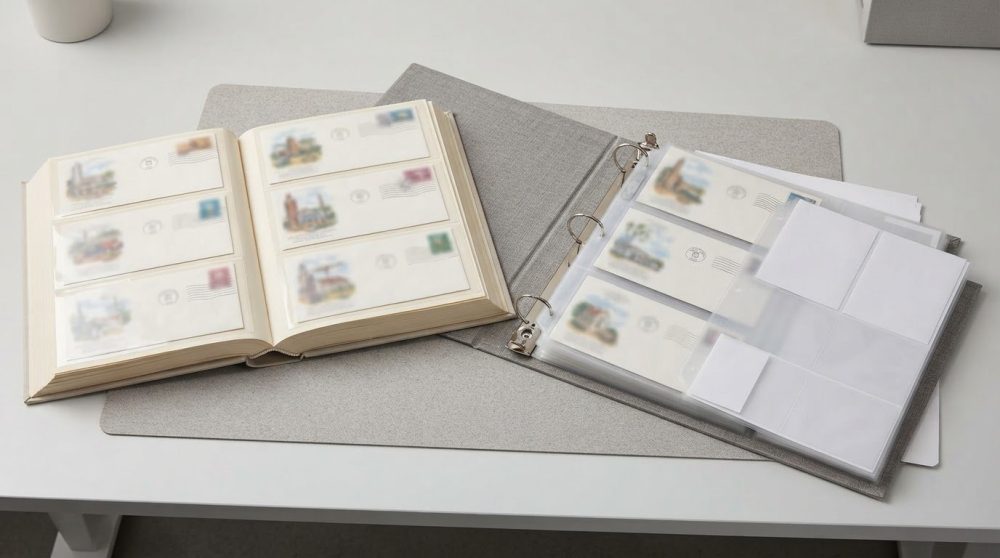
Compare the page layout, how many covers it accommodates and whether it fits the binder system you intend to use. A higher number of pockets per page can suit smaller covers or a compact display, while a single-cover layout gives each envelope more space. Actual capacity depends on the page design and cover dimensions, so don’t assume a stated album capacity applies across different layouts.
| Format or layout | Covers per page | Binder compatibility |
|---|---|---|
| Fixed-page album | Set by the supplied page layout | Pages are intended for the album they belong to |
| Binder with refill pages | Varies by page layout | Check that replacement pages match the binder system |
| Single-cover layout | One cover in each space | Confirm the page fits the chosen binder |
| Multiple-cover layout | Several covers, depending on pocket arrangement | Confirm both page and binder compatibility |
Check fit, page layout and material before choosing
Measure representative covers, including the largest in your collection, then compare those dimensions with the stated page or pocket dimensions. Allow enough room to insert and remove each cover without forcing its edges. A consistent layout also gives you a repeatable way to arrange and browse covers by issue, date or subject.
Check the material description rather than judging a pocket by appearance. PVC contains plasticisers that can migrate over time and affect stamps or covers; polypropylene and polyester are inert alternatives used for archival storage. The NEDCC guidance on plastic storage explains why material choice matters. Choose pages or sleeves specified as PVC-free, and keep covers away from direct sunlight.
Before adding pages, confirm they’re designed for the binder system you own. Compatibility shouldn’t be assumed across systems, even if pages appear similar. Compare the First Day Cover Albums available at Renniks with your cover sizes, preferred page arrangement and binder requirements.
Choose a First Day Cover Album That Fits Your Collecting Plan
Start with how the collection is organised, not an assumed capacity. A small group of covers from one issue may suit a compact arrangement, while a collection spanning different envelope sizes or themes may benefit from a format that leaves room to sort items clearly. Decide whether you prefer to file covers chronologically, by stamp subject or by another consistent system. A simple contents note or page label can make those choices easier to follow as the collection grows.
Expansion depends on compatibility. Refill pages must fit the binder system they’re designed for, and similar-looking pages from different systems shouldn’t be assumed to interchange. Before settling on a format, consider whether you can continue using the same page and binder arrangement as you add covers, rather than needing to reorganise the collection later.
Make the next album decision practical
Use this checklist to compare options against the collection you have now and the way you expect to organise it:
- Collection format: Note whether your covers are uniform or include a range of sizes.
- Cover fit: Compare larger examples with the stated pocket dimensions.
- Page arrangement: Choose spaces for single covers or layouts for several items, according to how you want to view them.
- Stated material: Look for acid-free paper and pages or sleeves specified as PVC-free.
For broader context on Australian philately, Renniks’ Stamps of Australia catalogue provides a reference point for Australian stamp issues. Once you’ve identified the layout and fit requirements that suit your covers, explore the first day cover album options available from Renniks without assuming that page capacity or compatibility is the same across formats.
Set Up Your Collection for What Comes Next
A well-chosen first day cover album gives your collection a clear structure that can continue to serve as new covers are added. Keep a note of the page system and the order you’ve used, so future additions can be filed consistently rather than disrupting an arrangement you’ve built over time.
Renniks has supported Australian collectors since 1947 and is a recognised member of SCDAA, ANDA and APTA. That long connection to the collecting community informs a practical approach to choosing storage for philatelic material. Review the available album options against your covers and preferred arrangement, then take the next step with a format that suits your collection.
A considered choice now can make your covers easier to revisit and organise as your interests develop.
Shop the supplies in this guide
Put the advice above into practice with these collecting supplies from Renniks:
- Album for 100 FDCs or letters in DIN long format, red
- Album for 100 FDCs or letters in C6 format, red
Frequently Asked Questions
What is a first day cover?
A first day cover is a philatelic item built around a stamp used on its first day of issue, with the envelope retained as part of the collectible. For your records, note the stamp issue and any cachet text or artwork alongside the postmark details. This description helps distinguish the complete cover from a loose stamp removed from its original postal context.
How do I choose the right first day cover album size?
Choose a format that accommodates your largest cover and suits where you plan to store the album. Consider the binder’s overall footprint on a shelf and whether the pages turn comfortably when filled. If you expect the collection to expand, allow room for additional pages within the system rather than selecting a format solely for the number of covers you own today.
Do first day cover album pages need to be PVC-free?
Yes. PVC-free plastic is the appropriate choice for pages that stay in contact with covers over time, since PVC plasticisers can migrate and affect paper or stamp gum. Also check the other materials in the page and album: a PVC-free pocket alone doesn’t establish that paper inserts or backing boards are acid-free.
Can I store different sizes of first day covers in one album?
Yes, if the chosen pages can accommodate each format without bending or crowding. A collection with occasional oversized covers may be easier to manage in a separate album than by forcing those items into pockets intended for smaller envelopes. Keeping distinct groups in separate volumes can also make handling and browsing more straightforward.
Disclaimer
This article is provided for general information and collecting guidance only, and is not financial or investment advice. Coins, stamps, banknotes and trading cards can fluctuate in value, and nothing here should be read as a guarantee that any item will increase in value. Any value mentioned reflects a reference-guide estimate at the time of writing, not a current market valuation; always check the latest edition of Renniks Australian Coin & Banknote Values or an independent source for current figures. Renniks does not grade, authenticate or appraise items; grading opinions belong to independent third-party services such as PCGS and NGC. Links to external websites are provided for reference only; Renniks is not responsible for the content of third-party sites.
