



Coins
Coin Chest Meaning and Uses for Collectors
Nov
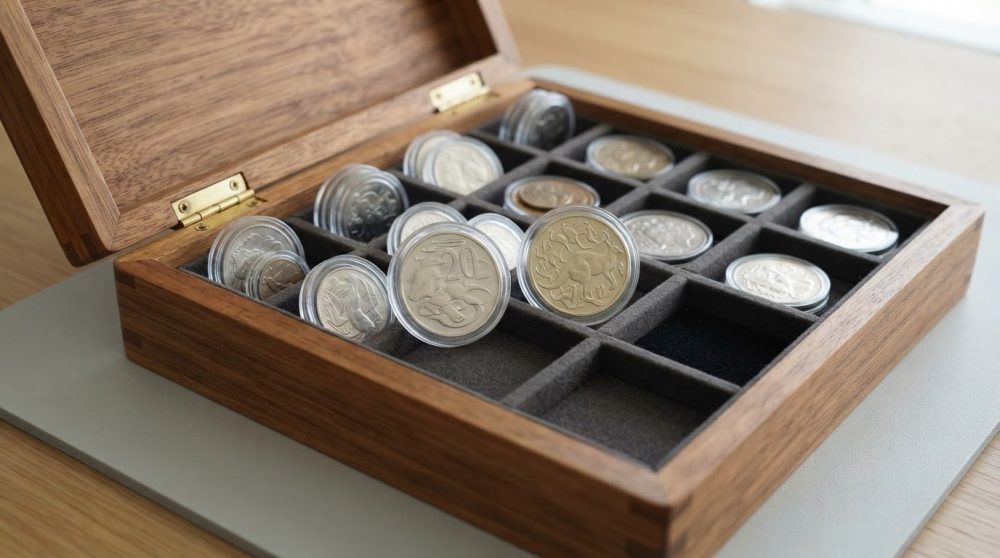
A coin chest does more than keep coins together. It is a box or case for organising, storing and sometimes displaying a collection, often with compartments or trays to keep pieces arranged. A chest is an outer storage format, not a substitute for suitable coin holders: bare coins can still be marked through handling or contact with other pieces.
The right choice depends on whether you plan to handle, display or store coins long term, as well as their sizes and current holders. This guide explains what coin chests are, how collectors use them and what to consider for Australian coins. It also distinguishes display chests from protective storage, so you can organise a collection while considering the materials in direct contact with each coin.
Key Takeaways
- Use a chest to arrange or display coins, and choose compartments that suit the sizes and holders in your collection.
- Keep raw coins in suitable holders rather than loose together, to reduce contact and handling.
- Choose PVC-free storage materials; plasticisers in PVC can damage coins over time.
- For storage beyond a chest, match Lighthouse Coin Capsules, 2×2 coin holders or an album system to how you organise and access your coins.
Coin chest
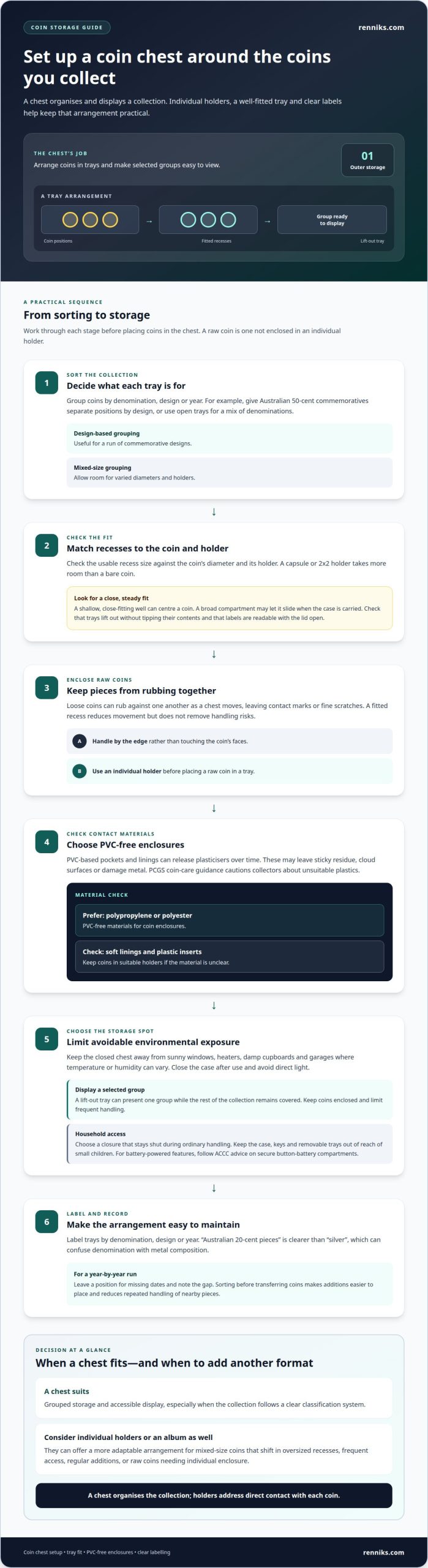
Tray depth and recess shape determine how coins sit and move inside a chest. A shallow, close-fitting well can keep a coin centred, while a broad compartment may let it slide when the case is carried. Assess the interior as a practical arrangement: trays should lift out without tipping their contents, and labels should be easy to read with the lid open.
The layout matters when a collection includes raw coins, meaning pieces not enclosed in individual holders. Loose coins can rub together as the chest moves, causing contact marks or fine scratches. A fitted recess reduces movement but does not eliminate handling risks. Hold raw coins by the edge and place each in a suitable individual holder before storing it in a tray.
Materials matter at the point of contact. PVC-based pockets and linings can release plasticisers over time; these may leave a sticky residue, cloud surfaces or damage metal. PCGS coin-care guidance cautions collectors about unsuitable plastics. Prefer PVC-free materials, such as polypropylene or polyester, for coin enclosures. If a chest has a soft lining or plastic inserts, keep coins in suitable holders rather than assuming the lining is safe. Avoid materials whose composition is unclear.
Choose a storage spot with stable conditions. PCGS advises collectors to avoid environmental exposure that can affect a coin’s surfaces. In Australian homes, keep a case away from sunny windows, heaters, damp cupboards and garages where temperature or humidity can vary. Close it after use and avoid direct light. These simple steps limit unnecessary exposure while keeping trays accessible for sorting.
Display involves a separate decision. A chest with a lift-out tray lets you present one group while keeping the rest covered. For example, you can show a tray of Australian commemorative designs without spreading the whole collection across a table. Keep coins enclosed during display and limit exposure to direct light, dust and frequent handling. A display case helps organise a collection, but it is no reason to handle coins by their faces.
Consider security and access in a household with children. Choose a closure that stays shut during ordinary handling, and keep the case where small children cannot reach loose coins or removable parts. If the chest has an electronic lock or other battery-powered feature, follow the Australian Competition and Consumer Commission’s (ACCC) advice on secure battery compartments that prevent children from accessing button batteries. Store keys and detachable trays with the case.
Before transferring coins, sort them into groups and record what each tray contains. A short label such as “Australian 20-cent pieces” is more useful than a general “silver” label, which may confuse denomination with metal composition. For a collection organised by year, leave a position for missing dates and note the gap. This makes additions easier to place and helps avoid repeatedly handling neighbouring coins.
- Match tray recesses to the coin diameter and holder dimensions.
- Use PVC-free materials where coins contact plastic.
- Keep the closed case away from heat, damp and direct sunlight.
- Label trays by denomination, design or year to support consistent sorting.
A chest suits collectors who want grouped storage and accessible display, especially when the collection follows a clear classification system. It is less suitable as the only protection for valuable raw coins, for mixed-size coins that shift in oversized recesses, or for collections that need frequent expansion. In those situations, individual holders and an album can offer a more adaptable arrangement. Choose a format based on how you store, view and add to your collection.
Renniks
Renniks offers storage formats that can complement a chest, depending on whether you prioritise display, access or organising coins by series. For raw coins, individual holders can reduce movement and direct handling; Lighthouse Coin Capsules and 2×2 coin holders provide options to consider alongside a chest’s tray layout. Lighthouse Album Systems offer another way to arrange coins in pages, which can suit collections grouped by denomination and date.
To explore formats for your collection, browse Renniks’ coin storage systems.
Plan the next stage of your collection
Storage can change as a collection grows. A coin chest may suit a carefully arranged display, while another format can make regular access or adding new pieces easier. Consider how you want to handle, organise and expand your collection, then choose storage that supports that approach. For protective options, Renniks offers Lighthouse coin capsules, coin tubes and albums. Explore the range to find a format that suits your coins.
Renniks offers Lighthouse Album Systems, Lighthouse Coin Capsules and 2×2 coin holders, giving collectors options beyond a chest. Explore these formats and consider which best suits your coins and collecting habits.
Shop the supplies in this guide
Put the advice above into practice with these collecting supplies from Renniks:
- Renniks Coin Album Plastic Refill Pages, 20 Pockets, Pack 10
- Renniks Coin Album Plastic Refill Pages, 63 Pockets, Pack 10
- Renniks Coin Album Plastic Refill Pages, 30 Pockets, Pack 10
- Presentation case for 20 Australian Kangaroo silver coins (1 oz.) in capsules
- Coin Trays L for 24 coins up to 47mm Ø, blue
- Coin Trays L for 15 coin holders up to 50x50mm, blue, packed by 2
Disclaimer
This article is provided for general information and collecting guidance only, and is not financial or investment advice. Coins, stamps, banknotes and trading cards can fluctuate in value, and nothing here should be read as a guarantee that any item will increase in value. Any value mentioned reflects a reference-guide estimate at the time of writing, not a current market valuation; always check the latest edition of Renniks Australian Coin & Banknote Values or an independent source for current figures. Renniks does not grade, authenticate or appraise items; grading opinions belong to independent third-party services such as PCGS and NGC. Links to external websites are provided for reference only; Renniks is not responsible for the content of third-party sites.
