





Coins
Australian Tradesmen’s Tokens: Penny and Halfpenny Listings
Nov
A catalogue listing for an Australian tradesmen’s token is a starting point, not a complete account of the piece. For anyone collecting Australian tradesmen’s tokens, comparing the description with the physical evidence helps separate documented details from later interpretation. A token can also offer a tangible connection to colonial Australia’s commercial life, beyond the brief information in a listing.
This guide covers penny and halfpenny entries alongside less common denominations, and explains how to read descriptions without treating a catalogue entry as a final verdict. Use a consistent method to record observations, distinguish evidence from attribution, and choose storage that makes examination possible with minimal handling. These habits support research, whether you’re documenting an inherited token or organising a broader collection of Australian issues.
Key Takeaways
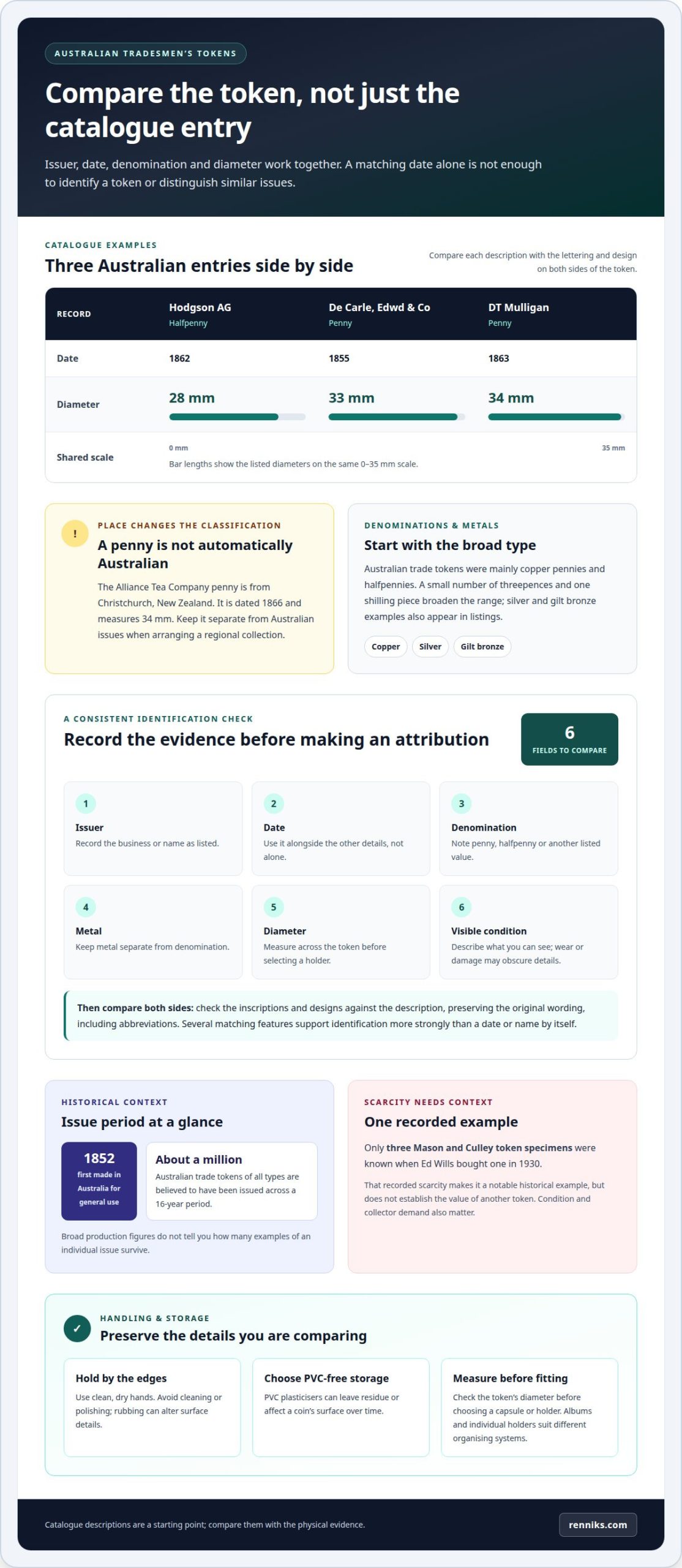
- Use the Hodgson AG halfpenny listing as a reference point: it is dated 1862 and measures 28 mm.
- Compare penny-token listings by issuer, date and diameter; the De Carle, Edwd and Co token is dated 1855 and measures 33 mm.
- Check the place of issue as well as the design: Christchurch penny tokens are New Zealand issues, not Australian tokens.
- Choose a storage format that suits how you organise the pieces, from Lighthouse Album Systems to coin capsules and 2×2 coin holders.
Australian halfpenny tokens
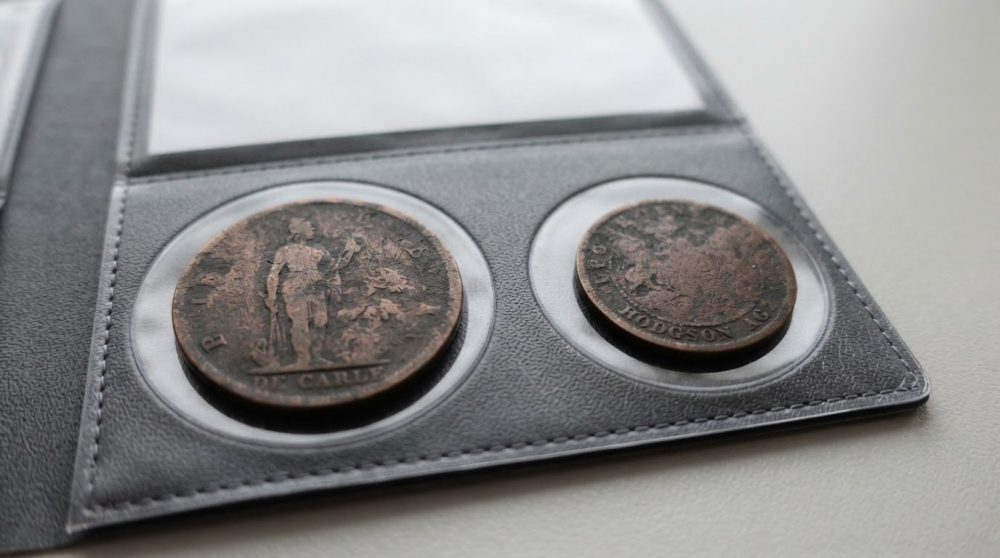
Halfpenny listings reward close attention to the physical description. A listed Hodgson AG token is dated 1862 and measures 28 mm across. Record the issuer, date, denomination, metal and diameter together, then compare the inscription and design with the coin. A matching date alone is not enough to distinguish similar issues or varieties.
Some pieces also have a documented collecting history. Reginald Scaife wrote about disposing of halfpenny discs on 9 September 1854. The James Nokes proof halfpenny has a separate institutional history: Von Guerard had given it to the National Gallery of Victoria by 1880, and the gallery received it on 15 March 1976. These details help separate a token’s provenance from its physical description.
Historical restrictions form part of the record. According to Wikipedia’s account of trade tokens, tokens were made illegal in Victoria in 1863, banned in New South Wales in 1868, and declared illegal in Western Australia in 1878. These dates describe historical state bans; they should be read as context for the period, not as a statement of current import rules.
For each halfpenny, record the inscription, date, diameter and visible condition. Hold copper pieces by their edges, and avoid rubbing deposits or toning from the surface. Store unmounted examples in PVC-free holders, as PVC plasticisers can leave residue or affect a coin’s surface. Keep provenance notes separate from observations made directly from the token.
Australian trade-token listings
A listing is most useful when you can compare its description with the token itself. Check the issuer, date, denomination, metal, diameter and condition before drawing conclusions.
Identifying and authenticating tokens
Compare the lettering and designs on both sides with a descriptive catalogue entry. For example, the 1855 De Carle, Edwd and Co penny measures 33 mm, while the 1863 DT Mulligan penny measures 34 mm. Matching several features supports identification more strongly than relying on a date or name alone. Wear, corrosion and damage can obscure details, so record what is visible without altering the surface.
Rare and valuable tokens
Rarity depends on how many examples are known; condition and collector demand also shape market interest. Only three Mason and Culley token specimens were known when Ed Wills bought one in 1930. That recorded scarcity makes it a notable historical example, but it doesn’t establish the value of another token. Compare condition and documented rarity rather than assuming every old issue is scarce.
Buying and selling tokens
In Australia, collectors can find tokens through specialist numismatic auctions, coin fairs and private sales. Compare listings with tokens of similar denominations and issuers, and look for clear images of both sides. If selling, describe visible features and disclose damage. Keep provenance records separate from your own attribution.
Handle tokens by their edges with clean, dry hands, and don’t clean or polish them. Store each piece in a PVC-free holder: PVC plasticisers can leave residue or affect coin surfaces over time.
What are the main types and denominations of Australian tradesmen’s tokens?
A useful starting point for collecting Australian tradesmen’s tokens is denomination. Australian trade tokens were mainly copper pennies and halfpennies, issued by merchants and businesses. A small number of threepences and one shilling piece broadened the range. Denomination helps organise tokens, but it doesn’t identify an issuer or prove where a token circulated.
The types also differ by metal, place and purpose. Copper issues dominate the surviving descriptions, while silver and gilt bronze examples appear in listings. For instance, an 1860 Hogarth & Erichsen silver threepence is distinct from a copper penny, even before its design or condition is considered. Record metal and denomination separately.
Dates help place tokens within the period of private issue. The first tokens manufactured in Australia for general use were issued in 1852. Across a 16-year period, about a million Australian trade tokens of all types are believed to have been issued. Those figures describe broad production, not the number of surviving examples for any one issuer.
Place names matter, too. The Alliance Tea Company penny from Christchurch, New Zealand, is dated 1866 and measures 34 mm. Its denomination resembles Australian pennies, but Christchurch identifies it as a New Zealand issue. Keep it separate from Australian pieces when arranging a regional collection.
A catalogue for collecting Australian tradesmen’s tokens can group pieces by denomination, then record the issuer, date, metal, place and diameter. Preserve the original wording of inscriptions, including abbreviations, because small differences can distinguish businesses or issues. Compare these notes with both sides of the token. For broader Australian coin references, See an example here.
Renniks: Lighthouse Album Systems
Renniks offers Lighthouse Album Systems, Lighthouse Coin Capsules and 2×2 coin holders for collectors organising documented trade tokens. Once you’ve recorded each token’s issuer, denomination and date, an album can help keep those records and pieces arranged consistently. Individual holders provide a separate option for storing selected examples.
Measure a token’s diameter before choosing a capsule or holder, then check that the format suits the piece. Handle copper tokens by their edges and avoid cleaning them, as rubbing can alter surface details used for comparison. Choose PVC-free storage, since PVC plasticisers can leave residue or affect coin surfaces over time.
For practical storage options suited to your token collection, contact Renniks or visit renniks.com.
Build a lasting record of your tokens
As you continue collecting Australian tradesmen’s tokens, let your catalogue grow alongside the collection. Add notes when new research clarifies an issuer or inscription, and keep those records with the relevant pieces. A consistent system makes earlier attributions easier to revisit and gives your research a clear path forward as the collection grows.
Renniks offers Lighthouse Album Systems, Lighthouse Coin Capsules and 2×2 coin holders for organising and storing collected coins. Choose a format that suits how you want to arrange and handle your tokens, then keep the catalogue details close to each piece. For information about these options, visit Renniks online.
Each careful note gives your collection a clearer history to build on.
Shop the supplies in this guide
Put the advice above into practice with these collecting supplies from Renniks:
- Renniks Australian & New Zealand Tokens Values
- Australians Awarded 2nd Edition
- Renniks Australian Pre-Decimal & Decimal Coin Errors
- Plastic box for 100 coin holders, blue
- MATRIX coin holders, white, inside Ø 22.5mm, self-adhesive, pack of 25
Frequently Asked Questions
What are Australian tradesmen’s tokens, and when were they issued?
Australian tradesmen’s tokens were privately issued coins used by merchants and businesses, particularly during shortages of official circulating currency. Merchants began distributing copper tokens to customers from 1849, with issues continuing through the mid-to-late 1800s. Most were pennies or halfpennies, though some other denominations appeared. Their inscriptions can identify the issuing business and help place an example in its local commercial history.
Which catalogues, museums, clubs, and online databases help research Australian tokens?
Start with Renniks Australian and New Zealand Token Values and C. W. Stainsfield’s 1883 catalogue for descriptions and historical classification. Museum Victoria’s Australasian tokens collection, which contains about 2,000 pieces, offers institutional examples for comparison. Search museum collection records by issuer or inscription, then compare findings with catalogue entries. Australian numismatic clubs can also provide a setting to discuss attributions and compare research notes with other collectors.
Are there Australian laws or import rules for collecting and trading historic tokens?
Historically, tokens were made illegal in Victoria in 1863, banned in New South Wales in 1868, and declared illegal in Western Australia in 1878. These are historical bans, not current import rules.
What are recent prices and auction results for Australian tradesmen’s tokens?
Disclaimer
This article is provided for general information and collecting guidance only, and is not financial or investment advice. Coins, stamps, banknotes and trading cards can fluctuate in value, and nothing here should be read as a guarantee that any item will increase in value. Any value mentioned reflects a reference-guide estimate at the time of writing, not a current market valuation; always check the latest edition of Renniks Australian Coin & Banknote Values or an independent source for current figures. Renniks does not grade, authenticate or appraise items; grading opinions belong to independent third-party services such as PCGS and NGC. Links to external websites are provided for reference only; Renniks is not responsible for the content of third-party sites.
