




Coins
1966 Australian Fifty Cent Coin: Silver Composition and Design
Nov
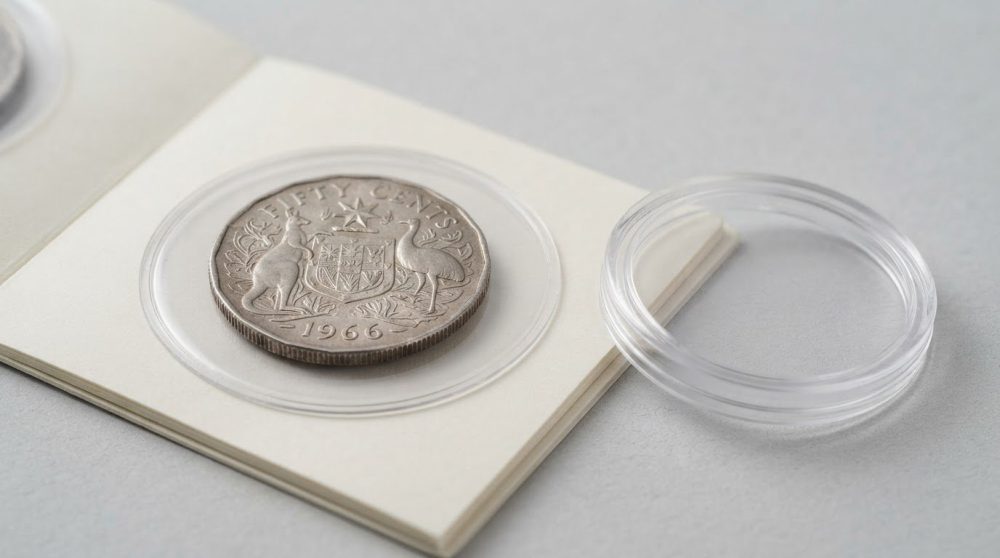
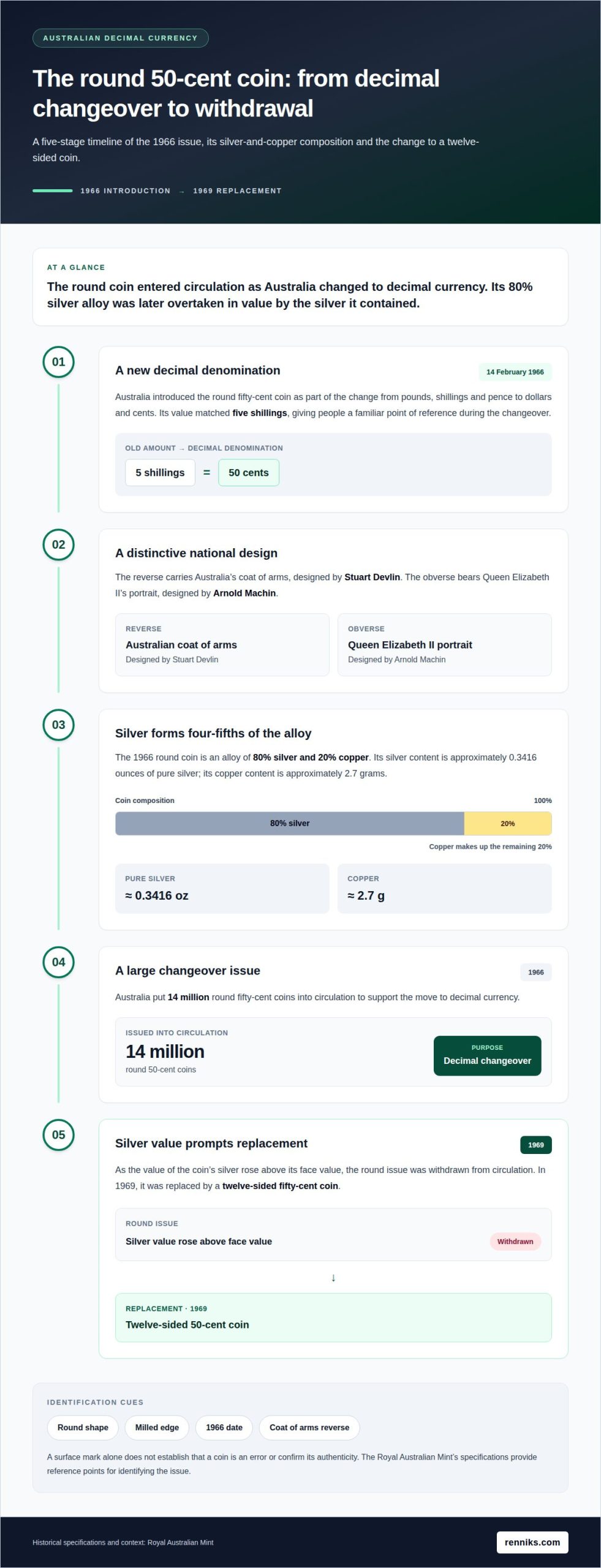
According to the Royal Australian Mint, Australia introduced the round fifty-cent coin on 14 February 1966 as part of the change to decimal currency. Its alloy is 80% silver and 20% copper, and Stuart Devlin designed its coat of arms reverse.
The Royal Australian Mint records that the round coin was replaced by a twelve-sided fifty-cent piece in 1969, after rising silver value led to its withdrawal from circulation. This article examines the coin’s design and composition, then places its introduction and withdrawal within Australia’s transition to decimal currency.
Key Takeaways
- Recognise the round coin by its Australian coat of arms reverse and Stuart Devlin’s design.
- Understand how the coin’s 80% silver composition led to its withdrawal from circulation.
- Place its introduction on 14 February 1966 in the context of Australia’s change to decimal currency.
- Choose a suitable coin holder or album system to organise and store a piece of this transition.
Australian coat of arms reverse
The reverse presents Australia’s coat of arms, while the obverse carries the monarch’s portrait. The Royal Australian Mint identifies Stuart Devlin as the reverse designer and records the coin’s defining physical specifications.
Coat of arms design
The coat of arms is Australia’s national heraldic emblem, reproduced on the coin’s reverse. Its central shield contains symbols representing the states, with a kangaroo and emu supporting it and the Commonwealth Star above. According to the Royal Australian Mint, Stuart Devlin designed this reverse in 1965. The arrangement gives the round issue a recognisable national design, distinct from later fifty-cent reverses.
Uncirculated coin value
An uncirculated coin has no wear from circulation, but its condition can still vary. There is no single value for every uncirculated example: grade, surface quality and collector demand all affect estimates. For a reference point, consult the current edition of Renniks Australian Coin & Banknote Values, which provides guide estimates, not fixed sale prices. Marks, cleaning and handling can affect an assessed grade.
Appearance and specifications
Specifications are the measurable features used to describe and identify a coin. The round fifty-cent issue can be described by its weight, diameter and thickness. Its edge is milled. The obverse bears Queen Elizabeth II’s portrait, designed by Arnold Machin; the Mint identifies the reverse as Devlin’s coat of arms design.
Errors and varieties
A variety is a recognised difference associated with a coin’s die; an error results from a production fault. The Double Bar name is used for a 1966 variety, but a mark that looks unusual does not by itself establish a variety or error. Compare the feature with a specialist reference, then consider the coin’s condition. Rarity alone does not determine a collector’s valuation.
Silver composition and withdrawal
The Royal Australian Mint identifies the 1966 round fifty-cent coin as an alloy of 80% silver and 20% copper. Its silver content is approximately 0.3416 ounces of pure silver, and its copper content is approximately 2.7 grams. These proportions distinguish the coin’s metal composition from later fifty-cent issues.
Alloy means a material made by combining metals. Here, copper makes up one-fifth of the coin, while silver forms the larger share. The Royal Australian Mint’s coin specifications describe this composition, which is why the 1966 issue is not a pure-silver coin. Its metal content matters when considering its history and collector interest.
The Royal Australian Mint explains that the round coin was withdrawn after the value of its silver rose above its face value. In other words, its metal value exceeded its denomination. Its withdrawal was tied to its silver content, not a change to its stated face value.
The Royal Australian Mint records that Australia replaced the round fifty-cent coin with a twelve-sided design in 1969. Shape offers a simple visual distinction between the 1966 issue and later coins. Their composition also differs: the round issue contains silver and copper, while later fifty-cent coins use a different metal composition.
To identify an example, compare its date and design with the recognised 1966 issue. The Royal Australian Mint’s specifications provide reference points for its material and physical features. The coin’s round shape and milled edge help distinguish it from the twelve-sided replacement. A surface mark alone does not establish that a coin is an error or confirm its authenticity.
1966 Introduction and decimal currency transition
Decimal currency expresses monetary amounts in dollars and cents rather than pounds, shillings and pence. Australia introduced the round fifty-cent coin on 14 February 1966 as part of this change. Its value matched five shillings under the Australian pound system, giving people a familiar equivalent during the transition.
The date marked a national change in how prices and payments were expressed. The new fifty-cent denomination helped Australians use decimal currency in everyday transactions, alongside the other new decimal coins. Australia put 14 million round fifty-cent coins into circulation, providing a practical supply for the changeover.
The coin’s five-shilling equivalence offered a direct point of reference for people adjusting to the new system. It connected an established amount in pounds, shillings and pence with the decimal denomination. That link helps explain why the fifty-cent coin had a prominent role in the 1966 change, beyond its distinctive design.
Its collector value depends on condition and demand, while its silver content also matters because the coin was withdrawn after silver’s value rose above face value. This separates the amount shown on the coin from the factors collectors consider. The coin reflects both a currency conversion and a change in the materials used in circulation.
To place the issue in context, compare its five-shilling equivalent with the decimal denomination introduced on 14 February 1966.
The coin preserved a familiar reference point: five shillings from the Australian pound it replaced, expressed as a new decimal denomination.
Renniks
Renniks helps collectors place Australian coins in context and choose suitable ways to organise them. For a 1966 round fifty-cent coin, the next step may be adding it to a decimal currency collection or storing it separately from circulating change.
Collection format guides the choice. Traditional album systems provide a bound option, while a coin kept individually can be stored in a holder suited to its size. Renniks offers specialised coin capsules and 2×2 coin holders for collectors organising individual pieces alongside broader sets.
Sorting through historical coins is often a relaxing, methodical hobby.
For a coin with silver content, avoid unnecessary handling and keep it away from materials that may affect its surface. Contact Renniks if you’d like guidance on the available collecting and storage options for your Australian coins.
Give your coin a considered place in your collection
A thoughtful place in your collection lets this piece of Australian history remain accessible for future study.
Shop the supplies in this guide
Put the advice above into practice with these collecting supplies from Renniks:
- Renniks Australian Pre-Decimal & Decimal Coin Errors
- Renniks Australian & New Zealand Tokens Values
- Renniks Australian Coin & Banknote Values 33rd Edition, Softcover
- Presentation case for 20 Australian Kangaroo silver coins (1 oz.) in capsules
- Presentation case for 20 Kookaburra silver soins in capsules, black
Frequently Asked Questions
Why was the Australian 50 cent coin introduced in 1966?
It was introduced as part of Australia’s change from pounds, shillings and pence to decimal currency. Released on 14 February 1966, the new fifty-cent denomination represented five shillings in the former system. That equivalence gave people a familiar reference point as prices and payments shifted to dollars and cents.
How many 1966 Australian 50 cent coins were minted?
The listed mintage for the 1966 circulation issue is 36,252,000 coins. This figure refers to the standard coin made for everyday use, not every 1966 fifty-cent coin type. Proof coins, including those issued in proof sets, are recorded separately, so mintage figures should be matched to the specific issue being discussed.
What metals are in the 1966 Australian 50 cent coin, and how much does it weigh?
It contains 80% silver and 20% copper, and weighs 13.28 grams. The alloy means it is not pure silver: the silver portion accounts for approximately 0.3416 ounces of pure silver, while the copper contributes to the coin’s remaining metal content. These specifications can help distinguish the round issue from later fifty-cent coins.
What is the current value of a 1966 Australian 50 cent coin in circulated condition?
Collector value can vary with condition and demand, and the coin’s silver content also matters.
Disclaimer
This article is provided for general information and collecting guidance only, and is not financial or investment advice. Coins, stamps, banknotes and trading cards can fluctuate in value, and nothing here should be read as a guarantee that any item will increase in value. Any value mentioned reflects a reference-guide estimate at the time of writing, not a current market valuation; always check the latest edition of Renniks Australian Coin & Banknote Values or an independent source for current figures. Renniks does not grade, authenticate or appraise items; grading opinions belong to independent third-party services such as PCGS and NGC. Links to external websites are provided for reference only; Renniks is not responsible for the content of third-party sites.
