



Stamps
Philatelic Research: A Practical Guide to Studying Stamps
Oct
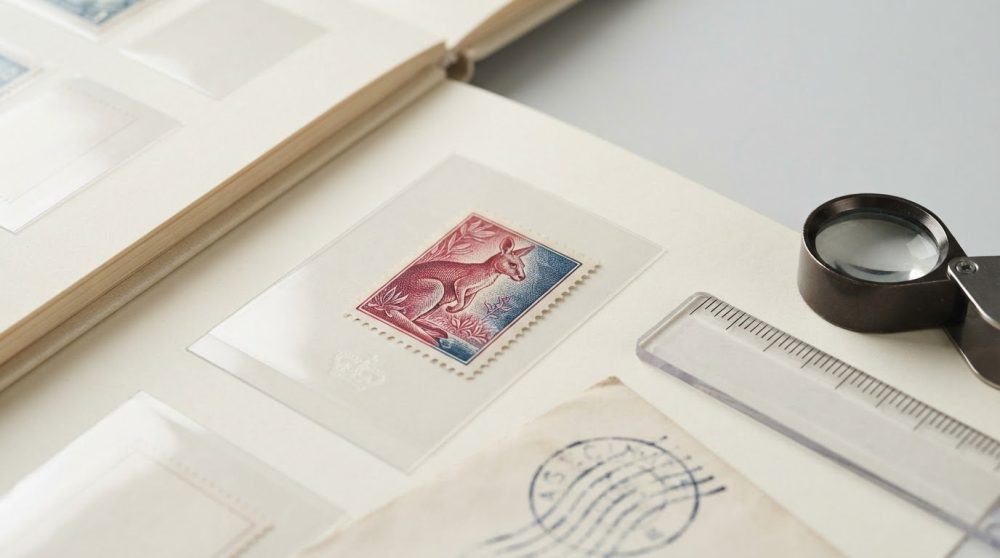
A catalogue listing can suggest an issue, but it cannot answer every question about the stamp in your hand. Philatelic study examines stamps as physical objects and postal evidence, using details such as perforations, watermarks, gum and cancellations to investigate when, where and how an item was used. For a cover, the surrounding postal markings may be as informative as the stamp itself.
Collecting and studying overlap, but research adds a documented basis for understanding a stamp’s identity, condition and context. This guide shows you how to examine physical evidence, choose references for specific questions and record findings clearly. General works such as Renniks’ Stamps of Australia, specialist catalogues such as the Australian Stamp Catalogue by Brusden White, and Australia Post’s philatelic resources can each help with different parts of an investigation. The aim is to turn an initial observation into a useful, traceable research note.
Key Takeaways
- Philatelic study goes beyond assembling stamps to include postal history and documented evidence.
- Record visible features and condition before deciding what they mean.
- Choose a reference that fits your question, then note its title and the evidence supporting your conclusion.
- Treat catalogue estimates as reference points, not guaranteed sale prices, and record questions that remain unresolved.
Philatelic study: what it covers beyond collecting stamps
Philately is the study and appreciation of stamps, postal history and related material. Collecting gives an item a place in a collection; systematic study asks what its features and use can tell us. Documentation then records the evidence and sources behind those observations. These activities overlap, but each has a different purpose.
Philatelic study treats stamps and postal material as evidence, rather than simply counting or accumulating items. A catalogue can help place a stamp within an issue, but its listing should be checked against the stamp itself. The overview of philately and its areas of study also describes the connection between stamp collecting and postal history.
Which material can philatelic study include?
A collection may include individual stamps, covers and postal markings. A cover is an envelope or other mail item retained with its original postal context. Its markings may include cancellations, dates, routing information or other postal impressions that help explain how it travelled or was processed. A first day cover album can help keep these envelopes organised and accessible for examination.
Postal history focuses on how mail was handled and marked, not only on the stamp that paid for postage. A stamp removed from an envelope retains its design and physical characteristics, but the intact cover may preserve evidence of its journey. The two formats can therefore answer different research questions.
Reference catalogues organise issues and describe distinctions to investigate, but they do not replace examination of the item. If you use Stanley Gibbons stamp references, treat an entry as a starting point. Record which visible details or postal markings support your identification, and note any features that do not match.
How to research a stamp using philatelic evidence and references
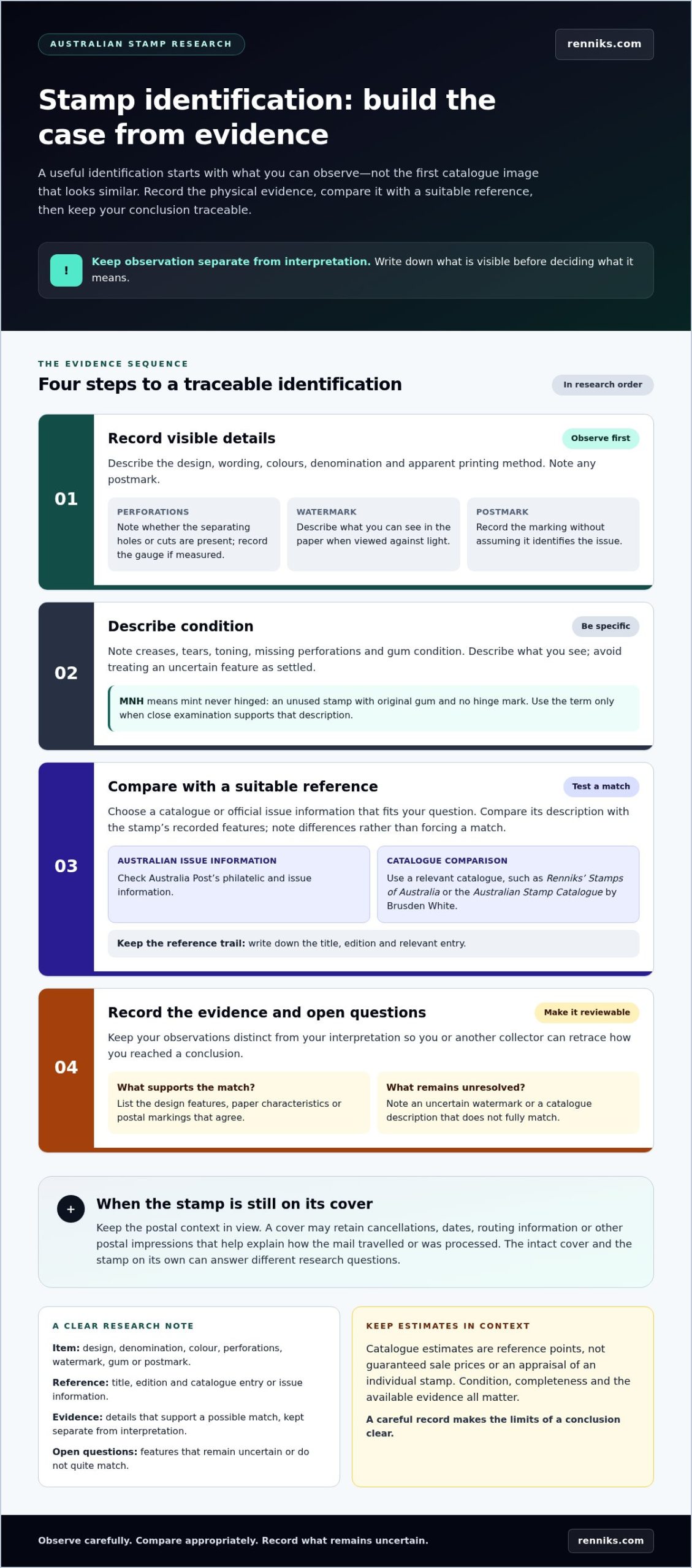
A reliable identification begins with what you can observe, not with the first catalogue image that looks similar. Keep your physical description separate from your interpretation, then use references to test possible matches.
- Record visible details. Note the design, wording, colours, denomination, apparent printing method and any postmark. Perforations are the small holes or cuts that separate stamps; record whether they are present and, if measured, the gauge. A watermark is a design formed in the paper during manufacture and viewed against light. Describe what you can see without assuming it identifies the issue.
- Describe condition. Note creases, tears, toning, missing perforations and gum condition. Mint never hinged (MNH) describes an unused stamp with original gum and no hinge mark. Write “gum appears intact” when that is what you observe; reserve “MNH” for a condition description supported by close examination.
- Consult a suitable reference. Compare your recorded features with a catalogue or official issue information. Note the reference title, edition and relevant entry. If a feature is unclear or the descriptions do not quite match, record the uncertainty instead of forcing an identification.
A catalogue entry is a research reference, not proof of a stamp’s identity or a guarantee of its value. Weigh its description and estimates against the physical evidence, and consider the limits of the catalogue’s coverage.
Match the reference source to the question
For details about an Australian issue, consult Australia Post’s stamp collecting information. Use a stamp catalogue to compare design and issue details, checking that its edition and coverage suit the item you are researching. In your notes, record the observations, the catalogue entry and any differences that remain. That is more useful for a later review than a catalogue number on its own.
For a relevant catalogue, explore the Stanley Gibbons catalogue range as one source in a documented research process.
Build a reliable philatelic reference practice for Australian stamps
A useful research record lets you or another collector retrace how you reached a conclusion. Keep your description of the stamp separate from catalogue information, and mark where the evidence agrees, differs or remains incomplete.
- Item: Describe the design, denomination, colour, perforations, watermark and gum or postmark condition.
- Reference: Record the catalogue title, edition and page or entry, along with relevant Australia Post issue information.
- Evidence: Note the details that support a possible match, such as a design feature or paper characteristic. Separate these observations from your interpretation.
- Open questions: Record anything you cannot resolve, such as an uncertain watermark or a catalogue description that does not fully match the stamp.
Catalogue estimates are reference points, not guaranteed sale prices, and they are not an appraisal of an individual stamp. Condition, completeness and the available evidence all matter. A careful record makes those limits clear rather than turning an estimate into a certainty.
Choose a reference that fits your collecting question
An Australian stamp catalogue is a practical starting point for researching Australian issues. Broader world-stamp references serve a different purpose, helping organise research across countries and their issues. In either case, check the edition and coverage, then record those details beside your observations. Renniks publishes Stamps of Australia and draws on long experience in Australian collecting. Its reference works can support research while leaving the final comparison grounded in the stamp itself.
For an Australian-focused starting point, browse the Australian stamp catalogue range. For broader coverage, compare your question with a Stanley Gibbons catalogue.
Carry your stamp research into the next question
Let an unresolved detail guide your next research step. Compare related stamps or covers, then record whether the feature recurs and what differs. This can reveal a pattern across an issue while keeping your conclusions tied to the evidence in front of you.
A concise note linking the item, the question and the reference consulted gives future philatelic research a clear starting point. Keep observations separate from tentative explanations, and update the record if stronger evidence changes your view.
Continue with a relevant catalogue and compare its entries with your notes. Renniks publishes Australian stamp references, including Stamps of Australia; browse Renniks’ stamp reference materials to find a starting point for your next question.
Shop the supplies in this guide
Put the advice above into practice with these collecting supplies from Renniks:
- Renniks Stamps of Australia 18th Edition
- Stockbook DIN A4 with stamps motif HOBBY, 16 white pages, blue
- Stamp Tweezers 32, de-luxe, 12 cm. Straight and spade shape.
- Stanley Gibbons 2022 Collect British Stamps Catalogue
- STANLEY GIBBONS 2024 Stamps Of The World – Set Of 6 Catalogues
Frequently Asked Questions
What does a watermark reveal about a stamp?
A watermark’s design, position and orientation can help distinguish printings or issues that otherwise look alike. Compare what you observe against a catalogue description, and note if the watermark appears reversed or inverted rather than treating that alone as a firm identification. Australia Post’s stamp collecting information is a useful reference point for Australian issues.
How do collectors measure stamp perforations?
Record horizontal and vertical measurements separately, especially if the edges appear to differ. Some stamps have compound perforations, so one figure may not describe all four sides. Compare the result with the relevant catalogue entry and note any damaged or missing teeth that could affect the reading. Australia Post’s philatelic resources provide a starting point for issue research.
What does mint never hinged mean in philately?
When assessing a possible MNH stamp, examine the reverse under good, even light for hinge marks, disturbed gum or other signs of mounting. Do not try to improve its appearance by cleaning or scraping the gum, as that changes the evidence you are assessing. Record visible condition separately from the catalogue description, and consult Australia Post’s stamp collecting information for issue context.
How is a first day cover different from an ordinary cover?
Compare the cancellation date with the stamp’s official issue date. A first day cover is distinguished by a cancellation made on that date; a commemorative design or cachet on the envelope may support the context, but does not by itself prove when the item was used. Australia Post’s philatelic information can help place an Australian issue in its release context.
Disclaimer
This article is provided for general information and collecting guidance only, and is not financial or investment advice. Coins, stamps, banknotes and trading cards can fluctuate in value, and nothing here should be read as a guarantee that any item will increase in value. Any value mentioned reflects a reference-guide estimate at the time of writing, not a current market valuation; always check the latest edition of Renniks Australian Coin & Banknote Values or an independent source for current figures. Renniks does not grade, authenticate or appraise items; grading opinions belong to independent third-party services such as PCGS and NGC. Links to external websites are provided for reference only; Renniks is not responsible for the content of third-party sites.
