





Coins
Coin Holder Comparison: Choosing the Right Format for Your Collection
Oct
A capsule isn’t automatically the best coin holder for every coin. The right format depends on the coin’s condition, how often you handle it and whether you want individual display or compact storage.
Use this comparison to weigh up holder types and materials, then match your choice to the way you organise your collection. Renniks supplies coin capsules, 2×2 holders and coin tubes for different storage needs.
In this article: Holder formats; PVC-free materials; choosing a holder for your collection.
By Renniks. This article provides general collecting information and is not a coin grading, authentication or valuation service.
Key Takeaways
- Match a coin holder to the coin’s condition, how often you handle it and whether you need individual display or compact storage.
- Choose PVC-free pockets or flips. Polypropylene and polyester are more suitable for long-term storage than flexible PVC.
- Use a correctly sized capsule for an individual raw coin, or tubes to store quantities of similar coins.
- Handle raw coins by their edges. Coins sealed in PCGS or NGC graded holders don’t need an extra capsule.
Coin holder types compared: flips, capsules, pockets and tubes
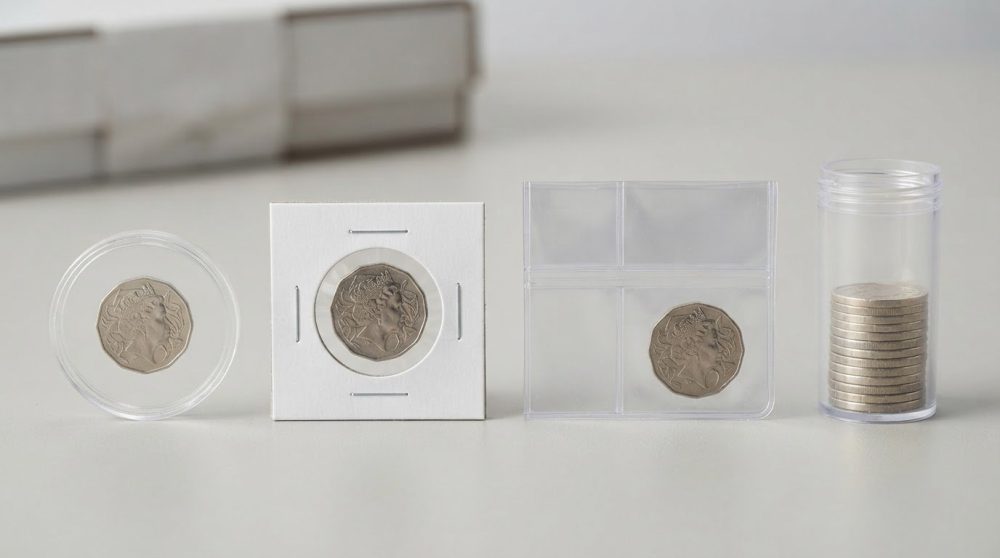
A coin holder is the individual housing or support around a coin; an album or storage box organises multiple holders. The format affects how easily you can inspect and identify a coin, and how it fits into your wider storage system. For 2×2 cardboard holders, self-adhesive and staple-closed versions both secure the coin behind a clear window. Self-adhesive holders avoid exposed staples, while staples need to be fastened carefully so they don’t scratch the coin or catch on neighbouring holders.
- 2×2 cardboard holders: Write the date, mint mark or variety on the card. The coin remains visible through the window, but you need to open the holder to remove it.
- Capsules: A direct-fit capsule is sized for a particular coin diameter and holds it firmly for individual viewing. Universal, or clamshell, capsules accommodate a range of sizes, but hold each coin less tightly.
- Pockets: PVC-free polypropylene or polyester (Mylar-type) pockets make coins easy to view and access. Check the material: plasticisers in PVC can migrate over time, leaving residue or etching a coin’s surface.
- Tubes: Tubes store groups of matching coins compactly. They suit quantity storage, but make it less convenient to view or identify an individual coin quickly.
Which coin holder format suits an individual coin?
For a raw coin, meaning one that isn’t sealed in a graded holder, choose a 2×2 or capsule according to how you want to store and view it. Match a direct-fit capsule to the coin’s diameter; a universal capsule is more accommodating if your collection includes mixed sizes. Tubes are better for grouped coins than individual display. To catalogue and arrange 2×2 holders, Lighthouse Matrix albums for 2×2 holders provide an organised album format.
PCGS- or NGC-graded coins are sealed in tamper-evident holders commonly called slabs. The holder displays the grade, so a slabbed coin doesn’t need an additional capsule. The coin slab reference describes their use by grading companies, while NGC’s grading scale explains numeric grades. Handle raw coins by their edges, even when the holder makes them easy to view.
Coin holder materials: why PVC-free storage matters
Material matters more than a holder’s clarity or flexibility. Check the packaging or product details for an explicit PVC-free statement. If the plastic type isn’t identified, don’t assume a clear window is suitable for long-term coin storage.
How to recognise a more suitable coin holder material
Look for named materials such as polypropylene or polyester, including Mylar-type film, and choose supplies described as archival-safe. These details are a more useful basis for comparing holders than appearance alone. PVC-free is an important selection criterion, but it can’t guarantee that a coin’s surface will never change.
Storage conditions matter too. Keep holders out of direct sunlight and away from damp areas and heat sources, particularly in rooms that become warm during an Australian summer. Humidity and heat can contribute to changes in coins, while a suitable holder material can reduce avoidable storage risks without controlling every environmental factor.
If you’re considering a pocket or another clear holder, check that its material is identified as PVC-free rather than relying on its appearance. Polypropylene and polyester/Mylar-type film are the material names to look for.

Choose a coin holder by condition, handling and collection plans
Start with the coin, then consider how you’ll use and store it. The right coin holder should suit the piece’s condition and your collecting routine, rather than forcing every coin into the same format.
Match the holder to the way you collect
- Assess condition. For a well-preserved raw coin you want to handle less, choose a holder that limits direct contact. Handle the coin by its edges only, and don’t clean it before storage.
- Consider access and visibility. A capsule gives an individual coin rigid housing for viewing. A 2×2 is easier to label and sort, making it useful when documenting dates, mint marks or varieties.
- Plan for the collection’s size. A few selected coins may suit individual capsules. For a growing group in 2×2 holders, a compatible album keeps pieces arranged and accessible. Match the album system to the holder format before building a larger run.
- Choose a suitable storage location. Keep coins away from direct sunlight, damp and heat sources. Environmental conditions can affect a coin regardless of its holder.
For pockets, choose material identified as PVC-free, such as polyester/Mylar-type film. A clear appearance alone doesn’t identify the plastic. Check the product details before adding pockets or other clear holders to your storage system.
Coins sealed in PCGS or NGC graded holders are already housed and don’t need an additional capsule. For raw coins sorted in 2x2s, coin albums for 2×2 holders let you organise the collection without changing each coin’s individual holder.
Build a storage routine that can grow with your collection
Choose a storage system you can maintain as your collection changes. Decide how you’ll catalogue new additions, record provenance or purchase details, and find a particular coin without handling it repeatedly. A consistent system also makes it easier to track gaps in a series and keep recent additions organised.
Renniks supplies 2×2 holders, coin capsules and coin tubes for practical collection storage. Use the comparisons above to choose a format that suits how you handle, view and organise your coins, and check the material details before selecting clear pockets or flips.
For a collection stored in 2×2 holders, an album can keep pieces arranged and accessible. Explore Renniks coin storage options and choose a coin holder that fits your collecting routine.
Shop the supplies in this guide
Put the advice above into practice with these collecting supplies from Renniks:
- MATRIX coin holders, white, inside Ø 22.5mm, self-adhesive, pack of 100
- MATRIX coin holders, white, inside Ø 35mm, self-adhesive, pack of 25
- MATRIX coin holders, white, inside Ø 30mm, self-adhesive, pack of 25
- MATRIX coin holders, white, inside Ø 32.5mm, self-adhesive, pack of 25
- MATRIX coin holders, white, inside Ø 20mm, self-adhesive, pack of 25
- MATRIX coin holders, white, inside Ø 35mm, self-adhesive, pack of 100
Frequently Asked Questions
Can a coin holder be reused after a coin is removed?
Sometimes, but reuse depends on the holder’s format and condition. A capsule may be reused if it remains clean, closes securely and fits the next coin correctly. For a 2×2, check that the clear window is intact and the card hasn’t creased. A staple-closed holder is usually opened by cutting or removing the staples, while a self-adhesive seal may not close reliably again. Replace any holder that’s damaged or contaminated.
Should I clean a coin before putting it in a holder?
No. Routine cleaning can leave fine hairlines or alter a coin’s surface, even if the change isn’t obvious at first. Handle it by the edges and place it in storage as found; don’t rub it with a cloth or apply household cleaners. PCGS guidance on cleaning coins explains why cleaning can harm a coin’s surfaces and affect its assessment.
Can I write on a 2×2 coin holder?
Yes. Use the cardboard exterior to record useful identification details, such as the denomination, year, mint mark or a variety note. Keep writing away from the viewing window, and never mark the coin itself. For a self-adhesive 2×2, label the card before placing the coin inside; for a staple version, leave the staples clear of your writing area.
Disclaimer
This article is provided for general information and collecting guidance only, and is not financial or investment advice. Coins, stamps, banknotes and trading cards can fluctuate in value, and nothing here should be read as a guarantee that any item will increase in value. Any value mentioned reflects a reference-guide estimate at the time of writing, not a current market valuation; always check the latest edition of Renniks Australian Coin & Banknote Values or an independent source for current figures. Renniks does not grade, authenticate or appraise items; grading opinions belong to independent third-party services such as PCGS and NGC. Links to external websites are provided for reference only; Renniks is not responsible for the content of third-party sites.
