




Knowledge Base, Stamps
Rare Australian Stamps: A Collector’s Checklist for Assessing Rarity
Oct
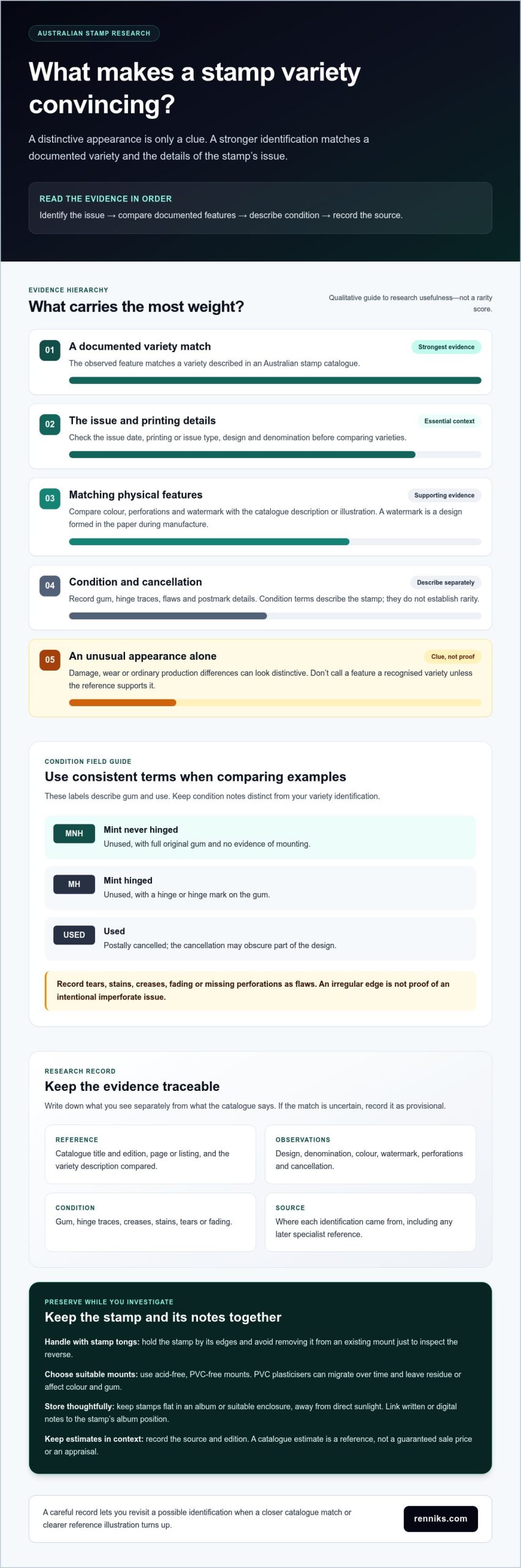
Age alone doesn’t establish rarity. To research rare Australian stamps, first identify the issue, then check whether a recognised variety is documented and compare the stamp’s condition with other examples. An unusual appearance can be a clue, but it isn’t proof of rarity.
This checklist shows what to record, how to compare a suspected variety with catalogue descriptions and how to keep research notes linked to the stamp. It also explains how to describe condition and choose storage while you investigate. The aim is to separate a supported identification from a tentative observation, so your collection records stay useful as you consult references or revisit a conclusion.
Byline: Renniks editorial team
Disclaimer: This article provides general collecting information and is not an individual stamp identification, authentication or appraisal.
Key Takeaways
- Record the stamp’s issue and visible features before drawing conclusions about rarity.
- Compare suspected varieties with catalogue descriptions so damage or ordinary production differences aren’t mistaken for a recognised variety.
- Describe gum, perforations and cancellation consistently when comparing examples.
- Research rare Australian stamps using dated catalogue references and source notes, then store them in acid-free, PVC-free mounts away from direct sunlight.
How to assess whether a rare Australian stamp is genuinely unusual
Rarity depends on evidence about the issue, any recognised variety, how many examples survive and the stamp’s condition. Age, a famous design or an unusual appearance doesn’t establish rarity. The same design can have several printings, while damage or wear can create differences that look significant at first glance. Start by recording observable details, then compare them with documented issues and varieties.
Begin with the stamp in its existing mount. Don’t handle its face or remove it just to inspect the back. Record the design, denomination, colour, perforations, watermark and cancellation. Perforations are the small holes separating stamps; a watermark is a design formed in the paper during manufacture; and a cancellation is a postal marking applied to a used stamp.
- Design and denomination: Record the subject and printed value.
- Colour and perforations: Describe the apparent shade and whether the edges are perforated or imperforate.
- Watermark and cancellation: Note any visible paper design and postmark details.
Start with the stamp’s issue and reference details
Compare your observations with an Australian stamp catalogue. Check the issue date, printing or issue type, and any listed varieties. A small difference is relevant only if it matches a documented variety, not simply because it looks distinctive. Renniks’ Australian stamp catalogues can help identify an issue, while the history of Australian stamps and postal services provides broader historical context.
Record the catalogue title and edition, page or listing, and the description that appears to match. Treat a catalogue entry or estimate as a research reference, not proof of scarcity or a guaranteed sale price. If you’re organising a mixed collection, keep stamp notes separate from records for items in coin and banknote storage systems.
Check a stamp’s variety and condition before calling it rare
A suspected variety should match a documented feature, rather than merely look different from another stamp. Compare its design and printing details with a catalogue illustration or description. Don’t clean, flatten or otherwise alter the stamp during your comparison.
Perforations and watermarks can help distinguish issues or listed varieties when their pattern, spacing or orientation matches the reference. Gum is the adhesive on the back of an unused stamp. Its presence and condition, together with any hinge trace, help describe the stamp accurately.
- Mint never hinged (MNH): Unused, with full original gum and no evidence of mounting.
- Mint hinged (MH): Unused, with a hinge or hinge mark on the gum.
- Used: Postally cancelled, with a cancellation that may obscure part of the design.
These terms describe condition, not rarity. A tear, stain, crease, faded colour or missing perforation may be damage rather than a printing variety. Record flaws separately. Don’t call an irregular edge an intentional imperforate issue unless the catalogue description supports that identification.
Compare the physical evidence without altering the stamp
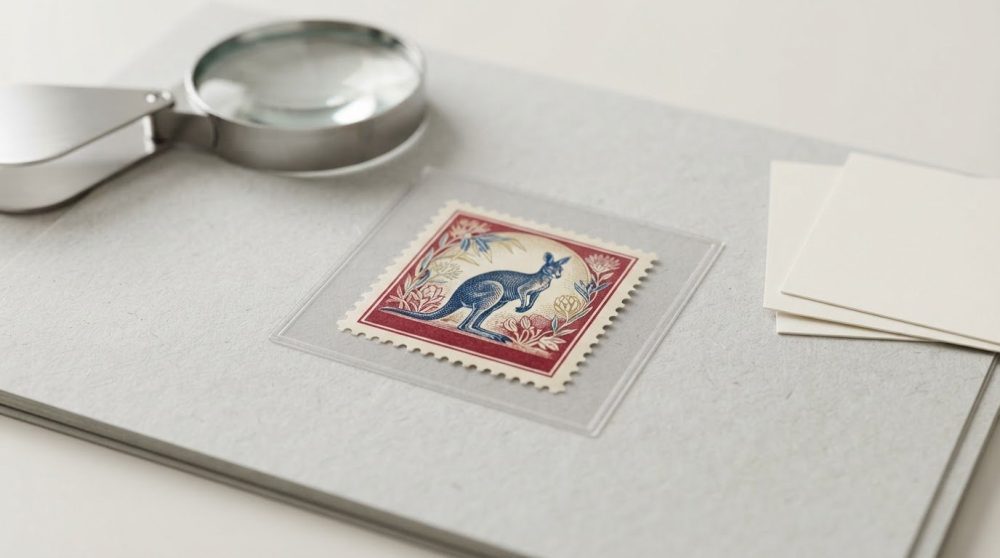
Examine the stamp under even light and use a magnifier to compare fine details with the reference. Avoid lifting hinges, testing the gum or applying watermark fluid during an initial check. These actions can affect the stamp or its condition. Keep your observations separate from the catalogue description so a tentative match doesn’t become a recorded fact.
For broader collecting and examination guidance, consult The Australian Philatelic Society Inc. and compare relevant entries in Australian stamp catalogues. Comparing documented features is a sounder basis for assessing rare Australian stamps than relying on appearance or condition alone.
Record your findings and preserve a rare Australian stamp
A clear record makes it easier to review an identification against further references. Note the catalogue title and edition, page or listing, observed features, the stamp’s condition and the source supporting each identification. Keep your observations distinct from catalogue descriptions so a possible match isn’t recorded as a confirmed variety.
- Reference: Record the catalogue details and the variety description you compared.
- Observations: Note the design, colour, watermark, perforations and cancellation.
- Condition: Describe gum, hinge traces, creases, stains, tears or fading.
- Source: Record where each claim came from, including any later specialist reference.
Keep the stamp and its research notes together
Handle stamps by their edges with stamp tongs. Avoid removing one from an existing mount just to examine the reverse. If you need to move it, work over a clean, uncluttered surface and link your written record or digital notes to its album position. That limits unnecessary handling and keeps the research connected to the item.
Use acid-free, PVC-free mounts and store stamps flat in an album or suitable enclosure, away from direct sunlight. Plasticisers in PVC can migrate over time and damage stamps, including by leaving residue or affecting colour and gum. HAWID stamp mounts provide a hingeless mounting option. Choose mounts that are acid-free and PVC-free.
A catalogue estimate is a reference, not a guaranteed sale price or an appraisal of an individual stamp. Keep the estimate with the source and edition details so future comparisons have a clear starting point.
Put your stamp research into practice
If a stamp remains difficult to identify, describe it provisionally in your records. Keep the notes with the collection and revisit the question when you find a closer catalogue match or a clearer reference illustration. This approach gives rare Australian stamps a documented context without turning uncertainty into a firm claim.
Renniks publishes Australian philatelic references for collectors. Use a catalogue as a working tool to compare issues and varieties, then keep your own record of the evidence behind each identification. A consistent process makes future research easier and keeps the stamp’s history connected to the item.
Browse Renniks’ stamp-collecting supplies for reference catalogues and hingeless mounts to support your research and storage.
Shop the supplies in this guide
Put the advice above into practice with these collecting supplies from Renniks:
- STAMPS- 100 USA
- STAMPS- 200 REP DI GUINEE
- Renniks Premium Professional Stamp Tweezers Bent Spade 15cm, Black Sheath
- Folded Stamp Hinges FASTO
- HAWID MOUNT 210x33mm – CLEAR[PK25]
- Len Jury 2026 New Zealand Stamp Catalogue
Frequently Asked Questions
Can an inherited Australian stamp collection be sorted without removing stamps from its album?
Yes. Photograph each album page and give the image a page number that matches your inventory. Add the stamp’s visible details and any possible catalogue match to that record, marking uncertain identifications as provisional. You can sort your research by issue or period without disturbing stamps, hinges or mounts, while retaining the album’s original order as useful context.
Does a catalogue estimate guarantee what a rare stamp will sell for?
No. A catalogue estimate is a reference, not a guaranteed sale price or an appraisal of an individual stamp. Collectible values can vary with condition, rarity and demand. Before using an estimate for comparison, check that the catalogue entry describes the same issue and variety, and note its edition. Differences in gum or cancellation can make two examples poor comparisons.
Can damage make a stamp look like a rare printing variety?
Yes. A torn edge may resemble a missing perforation, while fading or a stain can make the colour appear unusual. Compare the feature’s position and form with a catalogue illustration and, if possible, another example of the same issue. A ragged edge alone doesn’t establish a variety. Don’t trim, soak or press a stamp while researching rare Australian stamps.
Disclaimer
This article is provided for general information and collecting guidance only, and is not financial or investment advice. Coins, stamps, banknotes and trading cards can fluctuate in value, and nothing here should be read as a guarantee that any item will increase in value. Any value mentioned reflects a reference-guide estimate at the time of writing, not a current market valuation; always check the latest edition of Renniks Australian Coin & Banknote Values or an independent source for current figures. Renniks does not grade, authenticate or appraise items; grading opinions belong to independent third-party services such as PCGS and NGC. Links to external websites are provided for reference only; Renniks is not responsible for the content of third-party sites.
