



Stamps
How to Organise a Disorganised Stamp Collection by Material
Nov
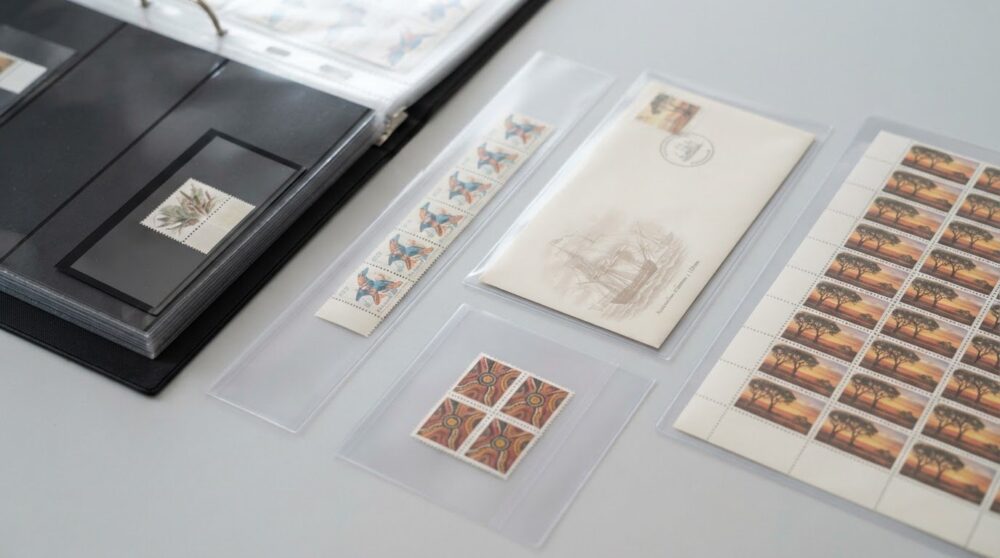
Let a stamp’s format guide its first storage location. Keep singles, covers, coils, blocks and sheets in spaces suited to their size and condition. Organising a disorganised stamp collection starts with separating these formats, then arranging stamps by country and issue date or by theme. For mint stamps, use PVC-free, hingeless mounts if preserving the original gum matters; traditional hinges are better reserved for lower-value used stamps.
A mixed or inherited collection can be loosely sorted into a stockbook before you choose permanent storage. This guide explains how to separate stamp formats, attach stamps without tape or glue, and choose storage that keeps items flat and protected from direct light. It also shows how to arrange each group so the system stays practical as you add issues, countries or themes.
Key Takeaways
- Separate stamps by format and condition before arranging them by country, issue date or collecting theme.
- Use PVC-free hingeless mounts for mint stamps when preserving their original gum matters; avoid tape and glue.
- Match storage to the item: singles, covers, coils, blocks and full sheets need appropriately sized spaces and support.
- Use an Australian stamp catalogue to organise issues by country and date, then choose a system flexible enough for new additions.
How Should I Sort Within Each Material Type?
Choose a filing rule for each group and note each stamp’s condition before assigning it a permanent place. Organising a disorganised stamp collection is simpler when related issues stay together.
-
Choose a Sorting System
Sort first by country, format or collecting purpose, then arrange each group chronologically. For Australian stamps, file issues by year; for a worldwide collection, separate countries before sorting their issues. Keep singles, covers, coils, blocks and sheets distinct. Avoid changing the rule partway through a series, as that makes gaps harder to spot.
-
Group Stamps by Country or Theme
Keep a country collection together and arrange its issues by date. For thematic collecting, group countries under a clear subject, such as birds, ships, flowers or space, then sort by issue year. A Christmas collection can use the same approach, grouping stamps from different countries by year. Keep complete series together and note each stamp’s country when the design doesn’t make it clear.
-
Create Working Categories
Label groups as mint never hinged, mint hinged, used, covers or full sheets. Separate stamps with original gum from postally cancelled examples, since gum condition helps describe an unused stamp. Add dividers for designers, colours or formats when they make items easier to find. When organising a disorganised stamp collection, leave room for new countries or themes to avoid rebuilding the arrangement later.
- Check possible rarities against a stamp catalogue, matching the country, issue, perforations and watermark. Compare condition as well: gum, hinge marks, cancellations and damaged perforations can distinguish examples of the same issue.
Before selling or insuring an inherited collection in Australia, make an inventory with photographs, condition notes and any available provenance. Keep related sets together and record catalogue references without cleaning stamps or removing mounts. Organising a disorganised stamp collection before making these decisions helps preserve item records and context.
Choosing storage for singles, covers, coils, blocks, and sheets
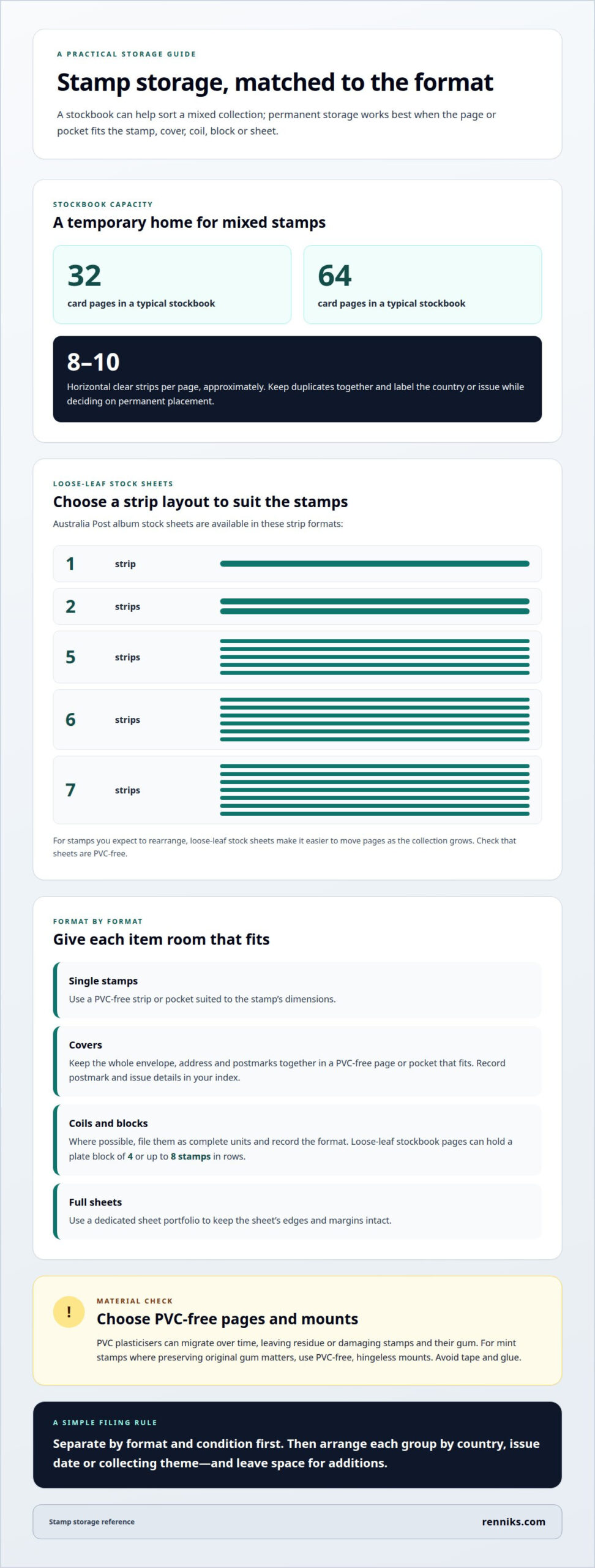
- Use a stockbook with PVC-free strips as a temporary sorting place for mixed loose stamps. PVC plasticisers can migrate over time, leaving residue or damaging stamps and their gum. Typical stockbooks have 32 or 64 card pages, with about eight to 10 horizontal clear strips per page. Keep duplicates together and separate them from the main reference copy. Add a small label identifying the country or issue while you decide on final placement.
- For single stamps, choose a PVC-free strip or pocket that fits their dimensions. Loose-leaf stock sheets work well if you expect to rearrange pages as the collection grows; check that the sheets are PVC-free. Australia Post album stock sheets come in one-, two-, five-, six- or seven-strip formats, so choose a layout suited to the stamps you’re filing.
- Keep covers separate from loose stamps. The envelope, address and postmarks are part of the item, so use a PVC-free page or pocket that fits the entire cover. Record its postmark and issue details in your index rather than removing the stamp to fit a smaller space.
- Where possible, file coils and blocks as complete units and record their format in your index. Loose-leaf stockbook pages can hold a plate block of four or up to eight stamps in rows. Store full mint sheets in a dedicated sheet portfolio, keeping their edges and margins intact.
- Place unidentified stamps in a labelled temporary section until you can match them to a country or issue. Keep their original groupings together and record any envelope or album notes that came with them. For loose-leaf arrangements, PVC-free Hagner sheets provide a format for arranging stamps in rows.
Keep one duplicate with the main issue and file the extras together. Store covers separately, and keep unidentified stamps grouped until you record their details.
Which stamp catalogues and apps are useful for organising a collection in Australia?
- Start with an Australian stamp catalogue to establish a consistent sequence for local issues. Use its country, issue and format details to label album sections and record gaps. Before assigning an identification, compare the stamp’s design and perforations with the catalogue entry. Keep the reference beside your notes so you can trace the decision later.
- Create a digital index in a spreadsheet or notes app, with fields for country, issue, subject, format, condition and storage location. For example, record a used Australian bird stamp by its catalogue reference and album page. Note if its watermark needs examination, and attach a photograph when similar designs are difficult to tell apart.
- For new Australian issues, use Australia Post’s philatelic information to keep your index current. Apply the same country, date and subject labels used for earlier entries. If you prefer a printed reference, Australian stamp catalogues can help maintain a consistent filing sequence as the collection grows.
Use catalogue details to guide your labels, then choose an index format that’s easy to update as new stamps arrive.
Renniks: Hawid Mounts for stamps
Renniks supplies Hawid mounts for stamps, a practical next step once loose issues are sorted and ready for album pages. Hingeless mounts hold stamps without a gummed hinge touching the reverse, helping preserve original gum on mint examples. PVC plasticisers can migrate over time, discolouring stamp gum or leaving residue, so choose mounts and pages that are PVC-free and acid-free. Select a mount that fits without pressing on the perforations.
For Australian stamps, a mount can keep an individual issue in place while leaving its design visible. Renniks’ Hawid mounts and Hagner sheets offer a way to organise mounted stamps in a loose-leaf format. Contact Renniks if you need assistance with choosing stamp mounts for your collection.
Make room for the next addition
A useful stamp system should accommodate new issues without forcing you to rearrange established pages. As the collection develops, update its index and labels when your interests change, while keeping records that preserve the context of unusual or inherited items. Organising a disorganised stamp collection is an ongoing process, not a one-off reset.
For a mixed collection, separate storage formats can support different material needs. Renniks offers Lighthouse Album Systems for albums, alongside Lighthouse Coin Capsules and 2×2 coin holders for coins. Choose storage according to the item, rather than trying to place every collectible in the same format.
A clear, flexible system gives each new addition a place.
Shop the supplies in this guide
Put the advice above into practice with these collecting supplies from Renniks:
- Folded Stamp Hinges FASTO
- SF strips 265x115mm double seal, clear backing film
- HAWID MOUNT 210x24mm – CLEAR [PK25]
- Renniks Premium Professional Stamp Tweezers Bent Spade 15cm, Black Sheath
- Renniks Premium Professional Stamp Tweezers Pointed 15cm, Blue Sheath
- STANLEY GIBBONS 2024 Commonwealth & British Empire Stamps Catalogue 1840-1970
Frequently Asked Questions
Hinges, mounts or hingeless pages: how do I attach stamps safely?
For a stamp worth mounting, select a mount with enough clearance that its edges and perforations aren’t compressed. Check the stamp’s dimensions before cutting or attaching the mount, and test the fit with an inexpensive example first. Avoid adhesive tape and glue. Use Australia Post’s philatelic information to confirm issue details before labelling the mounted stamp.
How do I protect my collection long-term?
Keep a condition log so you can spot changes during later inspections. Record the date, storage location and any observed marks, stains or changes to the paper or gum. Handle stamps by their edges with stamp tongs, and avoid cleaning or pressing them. If an item changes, photograph it alongside its inventory entry and keep the record with the collection.
How do I store full mint sheets differently from single stamps?
Record each sheet as a complete unit, including its issue name, stamp count, margins and visible plate markings. Note whether it has been folded, trimmed or separated, since these details distinguish it from an intact example. Create one inventory entry for the sheet instead of listing each stamp separately. Australia Post’s issue records can help identify Australian releases.
What is the best way to organise a stamp collection?
Give each album page or storage compartment a reference code, then use the same code in a written or digital inventory. For example, a label such as “A-04” can direct you to a specific album and page without handling neighbouring stamps. Record duplicates separately by condition, so a mint example and a postally used copy aren’t confused during later sorting.
Which album system should I use?
Choose a binder and page format suited to the largest items you plan to store, not just standard single stamps. Covers need room for the full envelope, while mounted stamps need page openings that don’t press on the mounts. Check that replacement pages fit the binder and leave room for additions, so expanding one section won’t mean transferring the entire collection.
Disclaimer
This article is provided for general information and collecting guidance only, and is not financial or investment advice. Coins, stamps, banknotes and trading cards can fluctuate in value, and nothing here should be read as a guarantee that any item will increase in value. Any value mentioned reflects a reference-guide estimate at the time of writing, not a current market valuation; always check the latest edition of Renniks Australian Coin & Banknote Values or an independent source for current figures. Renniks does not grade, authenticate or appraise items; grading opinions belong to independent third-party services such as PCGS and NGC. Links to external websites are provided for reference only; Renniks is not responsible for the content of third-party sites.
