





Coins
Coin Collector Books: How to Choose One and Protect Your Coins
Nov
A coin album is safe for your coins only if its pages and pockets use suitable, PVC-free materials. A coin collector book can help identify key dates, varieties and errors and explain grading and value, but it does not protect coins simply by holding them.
It makes sense to want coins visible and organised, but the material touching them matters just as much as an album’s layout. PCGS warns that holders containing PVC can expose coins to plasticisers, which may leave residue or damage their surfaces over time. This guide explains what a reference book can tell you, how to assess album materials and when capsules or other storage formats may suit your collection better.
Key Takeaways
- Use a reference guide to distinguish key dates, mint-mark differences, die varieties and striking errors before drawing conclusions about a coin.
- Keep pre-decimal and decimal collecting interests in view when choosing a catalogue or album, so its coverage matches the series you collect.
- Compare a coin’s grade, condition and current reference-guide estimate; a catalogue supports research but does not replace professional grading or authentication.
- Match storage to your coins and collection format: Renniks offers Lighthouse Album Systems, coin capsules and 2×2 holders for organising and housing coins.
Key dates, varieties and error coins
A reference book helps narrow a coin’s identity by date, denomination, design and mint mark. In Australia, collectors may focus on pre-decimal issues, struck before 1966, decimal coins, or both. A key date is a year or issue that matters within a particular series. Use the Royal Australian Mint’s issue information to compare a coin’s date and intended design with the relevant release.
Record each coin’s details in a consistent order: denomination, date, mint mark, then any visible design difference. A variety is a difference associated with a particular die or striking, not simply a coin that looks unusual. A missing mint mark can prompt further investigation, but does not establish a recognised variety on its own. PCGS coin-error references distinguish minting errors from damage that occurs after a coin leaves the mint.
Error coins have a physical or structural defect caused during production. An off-centre strike, where part of the design misses the coin, is one example of a mint error; PCGS includes off-centre strikes among recognised error types. Compare the affected area with a normal example of the same denomination and date. Note whether the coin’s shape, edge or design is affected, rather than labelling every irregularity an error.
A coin collector book is a research aid, not proof of rarity or authenticity. Check that an entry’s date, denomination and variety characteristics match the coin. Record what differs and where, such as a possible missing mint mark or displaced design. These notes help identify the coin and distinguish a potential mint variety from damage acquired after striking.
Coin collecting and numismatics
Australian collections may focus on pre-decimal coins, decimal coins, banknotes or a combination. Choose a reference that covers the material you want to identify and study.
Choosing an Up-to-Date Guide
A current guide identifies its edition and the Australian series it covers. Check the publication details, date ranges and contents against your collecting interests. A decimal-coin guide, for example, may omit pre-decimal denominations or banknotes. Prices for Australian coin books vary by format, edition and scope, so there is no single price for every guide.
For a beginner, look for clear photographs, an index and explanations of catalogue terms. A guide organised by denomination and date can make a first collection easier to research. A specialist title may be more useful for a focused interest, such as errors or varieties.
Coverage of Coins and Banknotes
Broad Australian references cover both pre-decimal and decimal coins, while specialist books concentrate on a single series or coin type. Pre-decimal issues predate the 1966 changeover; decimal coin guides focus on the system introduced that year. Check the contents list to see whether the date range matches the coins you are cataloguing.
A combined coin and banknote catalogue can help with an inherited collection containing both formats. If you collect only decimal coins, a dedicated guide may offer more relevant detail. Beginners can start with a general illustrated reference, then add a specialist book when a particular denomination, error or variety becomes a focus.

Coin grading and value
A coin’s grade describes its condition, while a catalogue estimate provides a reference point for its value. Both depend on correctly identifying the coin and assessing its surfaces, wear and details.
For Australian coins, choose a guide that covers the relevant series and a recognised grading resource, such as the Australasian Numismatic Dealers Association Grading Guide for Australian Commonwealth Coins. Compare the coin’s wear, lustre and marks with grading descriptions. A photograph alone may not show every surface detail.
Catalogue Prices and Sale Prices
A catalogue estimate is a published reference; a sale price records what a buyer paid in a particular transaction. They may differ because condition, eye appeal, provenance, demand and sale circumstances affect what collectors are prepared to pay. Compare like with like: the same date, denomination, variety and grade. A circulated coin is not a direct comparison for a sharply struck, uncirculated example.
Values and Mintage Figures
Australian coin catalogues organise entries by denomination, date and variety, and may include value estimates or mintage information. Check the contents and individual entries before relying on either. Mintage describes the number produced, but does not establish a coin’s current value by itself; condition and collector demand also matter.
For Australian coin and banknote estimates, the latest edition of Renniks Australian Coin & Banknote Values is the 33rd edition. Use its entries as reference estimates, then account for the individual coin’s grade and variety. The catalogue includes over 4,900 images, which can assist with visual comparison.
Renniks
Renniks brings coin research and practical storage together for Australian collectors. Its coin and banknote catalogues help you compare dates, varieties and reference estimates, while album systems and holders organise coins for study and display. A catalogue supports identification and research; it is not a substitute for independent grading or authentication.
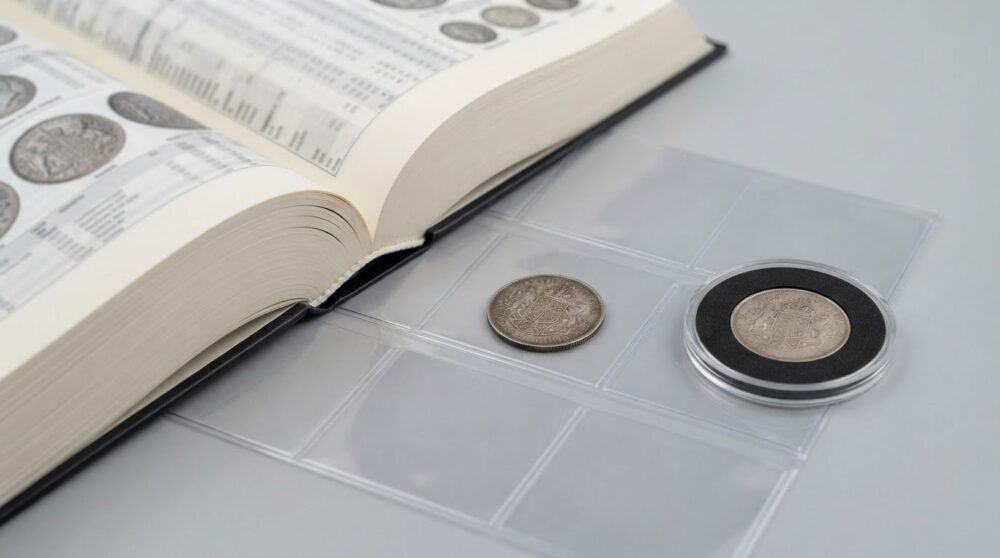
Choose storage to suit the collection: an album for a series, capsules for individual coins, or 2×2 holders for labelled examples. Renniks also offers HAGNER sheets and binders for collections that benefit from a flexible page format. If you need help choosing between these options for your collecting approach, contact Renniks.
Choose a storage approach that suits your collection
A coin collector book can guide your research, while a consistent storage system keeps each coin organised with its notes. Consider how you want to view and handle your collection as it grows, then choose a format that suits that routine.
Renniks offers Lighthouse Album Systems, Lighthouse Coin Capsules and 2×2 coin holders for different ways of housing and arranging coins. The right option depends on whether you prefer an album display or individual holders for selected pieces. Keeping your storage choice aligned with your collecting habits makes it easier to maintain a useful record over time.
A clear plan lets you continue collecting with care and purpose.
Shop the supplies in this guide
Put the advice above into practice with these collecting supplies from Renniks:
- Renniks Australian Pre-Decimal & Decimal Coin Errors
- Renniks Australian Coin & Banknote Values 33rd Edition, Softcover
- Renniks Australian Coin & Banknote Values 31st Ed. Softcover
- Coin Sheets NUMIS, 2 pockets for banknotes and postcards
- Coin Sheets NUMIS, 3 pockets for banknotes
- Coin Album NUMIS, with 5 pocket sheets, blue
Frequently Asked Questions
Are Coin Albums Safe for Your Coins?
Coin albums can be suitable if their pages or pockets are made from PVC-free material. PVC can release plasticisers that leave coins sticky, discoloured or etched over time; polypropylene and polyester are suitable inert alternatives. Check the material description before storing coins, and keep albums away from heat, damp conditions and direct sunlight. Avoid putting coins directly into unidentified plastic pockets.
Coin Albums vs Coin Folders: What’s the Difference?
A coin folder usually has fixed openings for a particular denomination or series, while an album commonly uses pages held in a binder. A folder can suit a defined set, such as circulating coins organised by date. An album offers more flexibility to rearrange or add pages as a collection changes. Choose according to whether you prefer fixed spaces or flexible organisation.
What is the best way to organise your coins?
Choose one organising principle, such as denomination, date or series, and apply it consistently. Keep duplicates together, but separate suspected varieties so they are not mistaken for ordinary examples. Add a simple record for each coin with its date, denomination, mint mark, acquisition details and research notes. This makes gaps easier to spot and helps you find a specific coin without repeatedly handling others.
What are the best coin collecting books for beginners in Australia?
A beginner’s coin collector book should focus on Australian issues, explain how its entries are organised and include clear images and practical descriptions. A broad reference such as Renniks Australian Coin & Banknote Values can introduce different series; a specialised guide can add detail on errors or varieties as your interests develop. Use catalogue estimates as research references, not guaranteed sale prices.
How much do coin collecting books cost in Australia?
Prices vary by title and format.
Disclaimer
This article is provided for general information and collecting guidance only, and is not financial or investment advice. Coins, stamps, banknotes and trading cards can fluctuate in value, and nothing here should be read as a guarantee that any item will increase in value. Any value mentioned reflects a reference-guide estimate at the time of writing, not a current market valuation; always check the latest edition of Renniks Australian Coin & Banknote Values or an independent source for current figures. Renniks does not grade, authenticate or appraise items; grading opinions belong to independent third-party services such as PCGS and NGC. Links to external websites are provided for reference only; Renniks is not responsible for the content of third-party sites.
