



Coins
Lighthouse box prices and product titles for coin storage
Nov
Compartment fit matters more than the box’s name. A Lighthouse box in the coin box/tray format has 48 compartments and is designed for coin capsules measuring 20 mm, 21 mm or 21.5 mm, making capsule size a useful starting point when comparing options.
A clear product title helps distinguish a tray for capsule-stored coins from the Lighthouse Intercept Box, which is designed for a different storage format. Compare prices without overlooking capacity, dimensions and the coin holders each box suits. Knowing which product titles to look for helps you narrow your choice to storage that matches the coins you keep.
Key Takeaways
- Compare box prices alongside capacity and format, so the cost makes sense for the coins you plan to store.
- Read product titles closely to distinguish a compartment tray from an Intercept Box intended for slabbed coins.
- Use the listed dimensions and capsule compatibility to judge whether a tray will suit your storage setup.
- Match the box to your collection: capsule-held coins and graded slabs need different storage arrangements.
Lighthouse box prices
Compare prices by storage purpose, not appearance alone. A box for a carefully arranged display serves a different need from one chosen for compact storage. Decide how you’ll use it, then assess whether its layout, finish and construction suit that purpose. This makes comparisons between listings more useful.
Check what the product description actually specifies. A velvet-red insert describes the lining, and a smoked-coloured drawer describes its finish. Neither detail identifies the outer shell material or establishes weatherproofing. Treat the box as dry-storage equipment, not a weatherproof container.
When comparing prices, consider usable capacity alongside the space the box occupies. A layout that suits your collection may be more practical than a cheaper option with compartments you can’t use. Consider where it will sit, how often you’ll access it and whether the arrangement supports your cataloguing habits. These measures help you assess value beyond the listed price.
Australian storage conditions also matter. Keep coins away from damp, heat and direct sunlight, whether they’re in a box or stored elsewhere. A storage case doesn’t replace a stable environment. Before placing your collection, make sure its intended location is dry and out of direct sunlight.
Compare listings for similar products. Distinguish coin trays from presentation cases and boxes designed for other holders. A clear product title and description show what the listed price covers. As a collector, choose a format that fits your collection rather than paying for features or finishes you don’t need.
Lighthouse box product titles
Read the product title carefully. Brand wording identifies the range, while later terms may describe the format or configuration. Treat each qualifier as useful identification, not decoration.
Available box types
“Lighthouse Intercept Box” names a distinct box format, while “Coin boxes MB” identifies another named range. These labels help you distinguish products before comparing their descriptions. Don’t assume two boxes have the same purpose just because both titles include “coin box”.
Look for terms that describe the holder or compartment design. A title referring to coin capsules signals a different arrangement from one naming slabs. Shape and finish terms, such as “round” or “smoke-coloured”, also distinguish configurations. Use the complete title when recording or comparing products.
Available box sizes
Some titles describe the layout rather than provide measurements. Terms such as “round compartments” and “square compartments” identify the compartment format, not the box’s outer dimensions or the space available in each compartment. Check the product description for those details.
A title referring to capsules indicates the intended holder category, not a universal fit. Capsule sizes vary, so the title alone may not answer every sizing question. Check the listing’s specific fit information before matching a box to holders you already use.
Colour terms help distinguish similar titles. “Smoke-coloured” and “grey-coloured” identify different finishes, while “red trays” and “black trays” describe tray colours. Keep these terms with the full product name in your notes to avoid mix-ups when comparing configurations or organising separate groups.
For an accurate comparison, record the full title, holder type, compartment shape and stated measurements. This gives each product a clear identity and helps you match a box to the coins you intend to store.
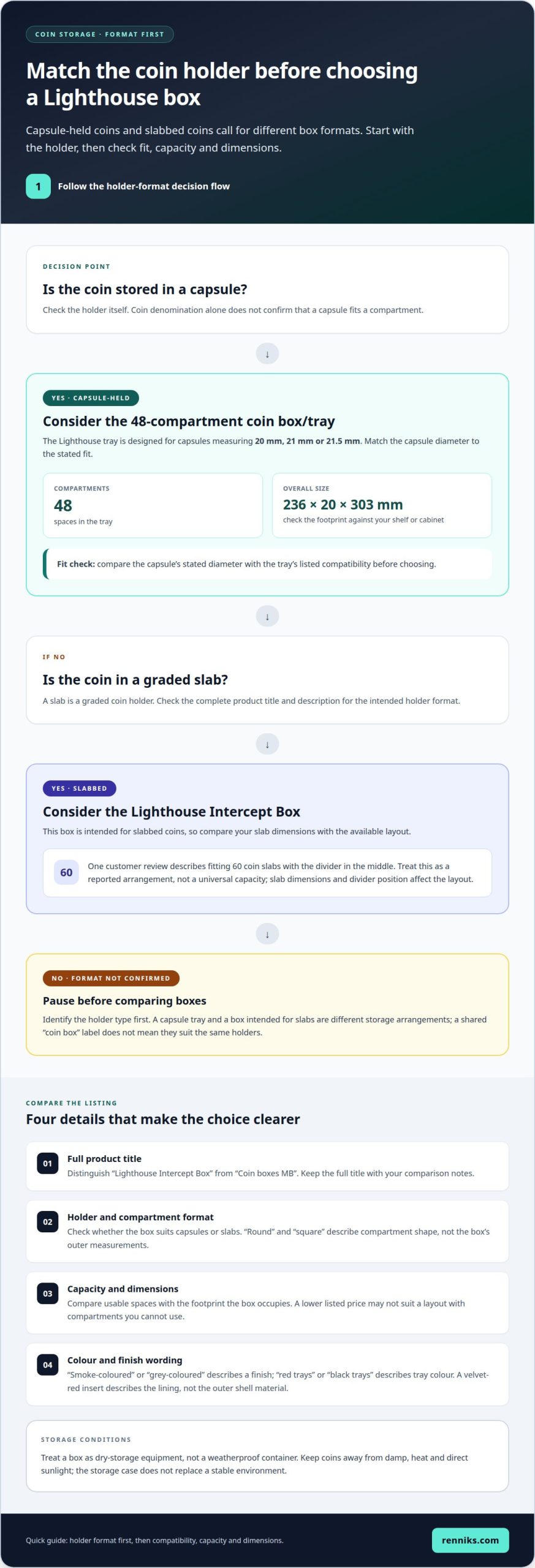
What types and sizes of lighthouse boxes are available?
The main options suit capsule-held coins or graded slabs. Compare the holder format first, then check dimensions and capacity. These details help distinguish a tray from a box designed for a different storage arrangement.
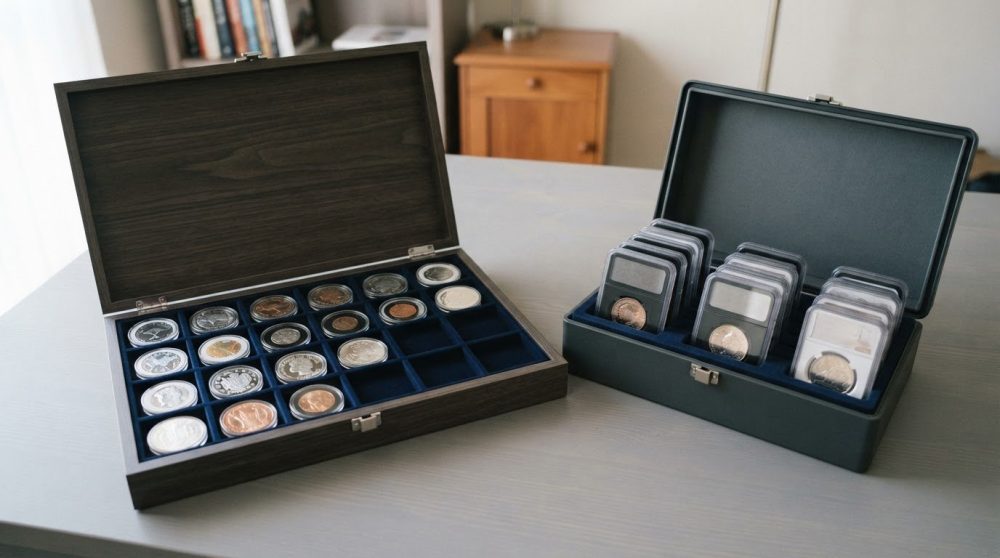
The compartment coin box/tray has 48 spaces. It is designed for capsules measuring 20 mm, 21 mm or 21.5 mm. Match the capsule’s diameter to the stated fit. Coin denomination alone won’t establish whether a capsule sits properly in a compartment. The tray measures 236 x 20 x 303 mm overall, so use these measurements to assess its footprint on a shelf or in a cabinet.
The Lighthouse Intercept Box is another type, intended for slabbed coins. One customer review describes fitting 60 coin slabs with the divider placed in the middle. Treat that as a reported arrangement, not a universal capacity. Slab dimensions and the divider position affect how the box is arranged. Compare your holders with the available layout before deciding.
If your collection is growing, consider how you group coins. A tray can organise capsule-held pieces by denomination, year or series, while slabbed coins may need a separate arrangement. Keeping the formats distinct can make individual pieces easier to find and reduce repeated handling.
Compare box styles and intended holders across the coin boxes and cases. Use the named format, stated fit and available space together. This gives you a practical basis for selecting storage that suits your collection.
Renniks
Renniks offers coin-storage options for collectors choosing between capsule trays, albums and other formats. Once you’ve identified the coin holder and box layout you need, compare those requirements with Lighthouse Coin Capsules, 2×2 coin holders and Lighthouse Album Systems. For collections that include stamps, HAGNER sheets and binders provide another format to consider.
The right choice depends on how you organise the collection. Capsules suit individual raw coins, while 2×2 holders keep coins visible in a compact card. Album systems organise stored pieces for viewing and reference. Matching the holder to the storage format helps prevent a mismatch between the coin and its compartment.
For guidance on selecting storage from these options, contact Renniks.
Plan a storage system that can grow
Choose a setup that supports how you organise coins now and accommodates future additions. A box works best as part of a consistent system, with holders and albums suited to how you handle, catalogue and revisit each piece. This can make it easier to place new additions without reorganising the whole collection.
Renniks offers Lighthouse Album Systems, Lighthouse Coin Capsules and 2×2 coin holders for collectors planning storage across these formats. Consider how each item will be housed before settling on a box, especially if your collection includes coins in different holders. A considered arrangement makes the next storage decision clearer.
A clear plan is a useful next step for any collection.
Shop the supplies in this guide
Put the advice above into practice with these collecting supplies from Renniks:
- Square Coin Capsules QUADRUM INTERCEPT, Inner Diameter 24mm, black
- QUADRUM Intercept coin capsule, inside Ø 21mm, black
- Coin Box 35 compartments for Lighthouse Capsules 29mm, smoke coloured
- Lighthouse Coin Tubes for US Nickels (Suits Australian $2 coin) (21.21mm)- Box of 100
- EVERSLAB Coin Capsules , Inner Diameter 34mm
- Wooden coin presentation case with 20 square blank fields, 50 x 50mm for QUADRUM, black
Frequently Asked Questions
What does “lighthouse box” mean in Australia?
In Australian coin collecting, “Lighthouse box” refers to a coin-storage product from the Lighthouse range, not a box for lighthouse memorabilia. Product titles distinguish compartment trays from boxes for slabbed coins. Match the named format to the holders in your collection before choosing.
What affects the cost of Lighthouse coin storage in Australia?
The cost of a Lighthouse box depends on its format and intended use. A tray for capsule-held coins and a box for slabbed coins are different products, so compare like with like. Check whether the layout suits your holders and collection; the brand name alone won’t tell you that.
What materials are lighthouse boxes made from, and are they weatherproof?
The box has a velvet-red insert and a smoked-coloured drawer, but these details don’t identify the outer shell material. Treat it as dry-storage equipment, not a weatherproof container.
How do lighthouse boxes compare with similar products?
Compare like formats by holder type, capacity and dimensions.
How do you assemble or use a lighthouse box?
To use the tray, match capsule diameters to its stated fit and arrange the coins in the compartments. Keep the box in a dry place away from heat and direct sunlight.
Disclaimer
This article is provided for general information and collecting guidance only, and is not financial or investment advice. Coins, stamps, banknotes and trading cards can fluctuate in value, and nothing here should be read as a guarantee that any item will increase in value. Any value mentioned reflects a reference-guide estimate at the time of writing, not a current market valuation; always check the latest edition of Renniks Australian Coin & Banknote Values or an independent source for current figures. Renniks does not grade, authenticate or appraise items; grading opinions belong to independent third-party services such as PCGS and NGC. Links to external websites are provided for reference only; Renniks is not responsible for the content of third-party sites.
