




Banknotes
How to Choose Safe Storage for Long Term Banknote Preservation
Nov
A clear sleeve is not necessarily suitable for a banknote. Long term banknote preservation depends on compatible materials and protection from damaging environmental conditions. Heat can cause Australian polymer notes to stick or distort, while older paper notes also need protection from damp and light. Preservation slows deterioration, but cannot reverse existing creases, stains or surface damage.
First identify whether your notes are paper or polymer, then choose storage that supports their size and condition without bending them. Consider how often you need to view or handle each note: a collection for regular study may need a different format from one kept mostly in storage. This guide covers handling, storage conditions, sleeves and archival materials to help you build a practical system for your collection.
Key Takeaways
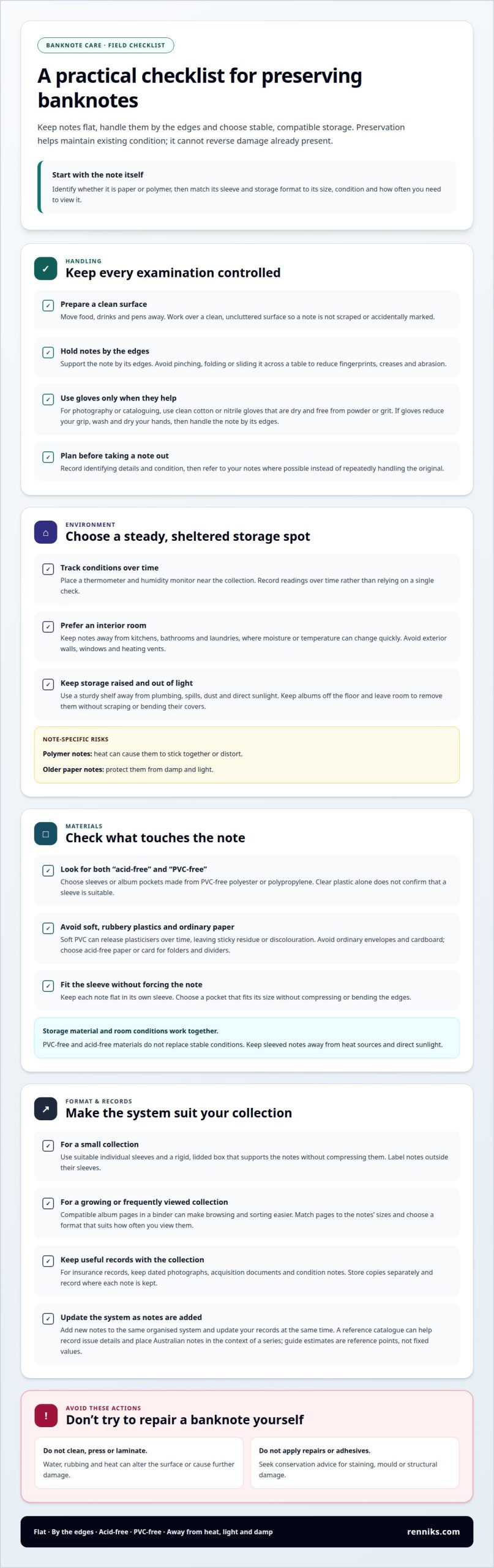
- Handle notes by their edges and keep them flat to reduce fingerprints, creases and surface wear.
- Choose a stable storage spot away from direct light, heat and damp conditions, and avoid attics or basements.
- Use acid-free, PVC-free sleeves or pages; avoid soft, rubbery plastics that can release plasticisers over time.
- Match the storage format to your notes, then use the Renniks Australian Coin & Banknote Values catalogue as a reference for Australian issues.
What Is Banknote Preservation?
Preservation slows deterioration through careful handling and suitable materials. Its purpose is to maintain a note’s existing condition, not repair damage.
-
Choose suitable gloves
Use clean cotton or nitrile gloves when examining a note, especially for photography or cataloguing. Make sure they’re dry and free from powder or grit that could transfer to the surface. If gloves make it harder to grip the note, wash and dry your hands, then hold it by the edges over a clean surface.
-
Handle banknotes carefully
Support a note by its edges and avoid pinching, folding or sliding it across a table. Place it on a clean, uncluttered surface, away from food, drinks and pens. Use acid-free, chemically stable materials for direct contact. Australian rules for owning or selling notes depend on the circumstances; export may involve cultural heritage controls, so don’t assume ordinary domestic handling rules also cover export.
-
Reduce unnecessary handling
Plan each examination before taking a note out of storage. Record its identifying details and condition, then refer to those notes when possible instead of repeatedly handling the original. Each additional handling creates another opportunity for fingerprints, creases or abrasion.
- Seek conservation advice for staining, mould or structural damage.
- Don’t clean, press, laminate or repair a banknote yourself. Water, rubbing, heat and adhesives can alter its surface or cause further damage.
- For insurance records, keep dated photographs, acquisition documents and condition notes. Store copies separately and record where each note is kept.
Where should you store paper money?
Storage is how notes are physically arranged; preservation is the care they receive over time. Choose a location and shelving arrangement that keep the collection stable and accessible.
-
Assess the storage environment
Place a thermometer and humidity monitor near the collection, and record readings over time rather than relying on a single check. Choose an interior room with steady conditions, away from kitchens, bathrooms and laundry areas where moisture or temperature can change quickly. Avoid spots beside exterior walls, windows or heating vents. Tracking conditions can reveal environmental patterns and help you choose a permanent storage location.
-
Choose safe storage and shelving
Use a sturdy shelf in a clean room, away from plumbing, windows and direct sunlight. Keep albums off the floor, where leaks, spills and dust can reach them, and leave enough clearance to remove them without scraping or bending the covers. Store binders flat when practical, without stacking heavy objects on top. A closed cupboard also limits dust and accidental knocks.
-
Consider budget storage options
For a small collection, start with suitable individual sleeves and a rigid, lidded box that supports the notes. Choose a box that fits without compressing its contents, and label notes outside the sleeves. As the collection grows, a binder with compatible pages can make browsing and sorting easier. Prioritise materials that touch the notes, then add display or organisation features as needed.
Acid-free and PVC-free storage materials
Choose pages and sleeves that are both acid-free and PVC-free. These material properties matter as much as a stable storage environment.
-
Select acid-free materials
Choose acid-free paper or card for folders, dividers and other materials that touch a banknote. Acidic materials can contribute to paper deterioration, so avoid ordinary envelopes and cardboard for collectible notes. Check product descriptions for an explicit acid-free statement rather than judging by appearance. You can pair acid-free materials with stable polyester or polypropylene sleeves to keep notes separate from surrounding paper.
-
Choose PVC-free protection
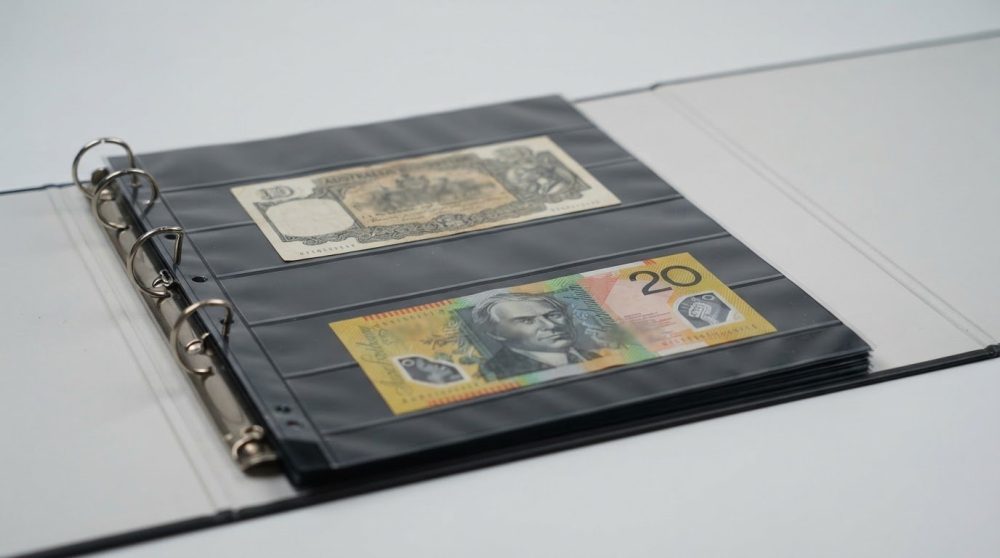
Choose individual sleeves or album pockets made from PVC-free polyester or polypropylene. Soft, rubbery PVC can release plasticisers over time, leaving sticky residue or discolouration on notes. Clear plastic alone doesn’t mean a sleeve is suitable. Keep each note flat in its own sleeve, and choose a pocket that fits without forcing or bending the edges.
- PVC-free and acid-free materials are suitable for long-term storage, but they don’t replace stable conditions. Heat, light and humidity fluctuations can still affect a note, so keep sleeved banknotes away from direct sunlight and heat sources.
- Use a dedicated protective sleeve for an individual note, or compatible pockets to organise several notes in an album. See an example here of sleeves intended for individual banknotes.
Renniks: Renniks Australian Coin & Banknote Values catalogue
The Renniks Australian Coin & Banknote Values catalogue provides a reference for Australian banknote issues and guide estimates. Use it to record a note’s issue details or place it in the context of an Australian series. Estimates are reference points, not fixed values, and condition remains important.
For an organised collection, match sleeves and pages to your notes’ sizes, then keep catalogue notes with your records. HAGNER sheets and binders offer another way to arrange collector material in a binder.
Contact Renniks for help choosing a suitable reference catalogue or storage material for your collection.
Make your storage system easy to maintain
For collections that also include coins, Renniks offers Lighthouse Album Systems, Lighthouse Coin Capsules and 2×2 coin holders. Choose storage according to each item’s material and format, rather than placing banknotes in coin holders. A suitable system can make it easier to organise and revisit a collection as it grows.
A considered next step can help you keep your collection arranged for the years ahead.
Shop the supplies in this guide
Put the advice above into practice with these collecting supplies from Renniks:
- BASIC Banknote Sleeves, for banknotes up to 170 x 86mm, pack of 50
- BASIC Banknote Sleeves, for banknotes up to 204 x 123mm, pack of 50
- BASIC Banknote Sleeves, to fit banknotes up to 158 x 75mm, pack of 50
- Renniks Banknote Album Plastic Refill Pages, 3 Pockets, Pack 10
- Renniks Banknote Album Plastic Refill Pages, 2 Pockets, Pack 10
- The John Bertrand New Zealand Coin and Banknote Catalogue 2021
Frequently Asked Questions
What are the best materials for long-term banknote storage and preservation?
Choose acid-free folders and sleeves made from polyester, polypropylene or polyethylene. These stable plastics are suitable alternatives to PVC, which can release plasticisers and leave deposits on a note. Check the material description, not just the sleeve’s clarity or flexibility. For a mixed collection, separate paper and polymer notes and use appropriately sized holders.
What temperature and humidity are ideal for storing banknotes long term?
Aim for 18-22°C and 45-55% relative humidity for paper banknotes. A thermometer and humidity monitor near the storage area can show whether conditions fluctuate. Readings help identify patterns, such as a damp cupboard or a room affected by seasonal changes. Avoid reacting to a single reading by moving notes between sharply different environments.
How should banknotes be handled to prevent damage?
Handle one note at a time over a clean, dry surface, using clean cotton or nitrile gloves. Support it by the edges rather than gripping the centre, and keep rings, food and drinks away from the workspace. If a glove catches on an edge or makes handling awkward, pause and adjust before moving the note.
Should banknotes be stored flat, in sleeves, albums, or archival boxes?
Store notes flat in individual PVC-free sleeves, then organise them in an album or archival box. Albums make series easier to view; boxes suit notes kept out of display. Don’t force oversized notes into pockets or overfill a binder, as pressure can bend edges. Choose a storage format that fits the notes.
How can banknotes be protected from light, moisture, mould, pests, and pollutants?
Keep albums or boxes closed in a dark, dry room, away from windows, pipes and household chemicals. An opaque cupboard limits light exposure, while dry, steady conditions reduce the chance of mould. Keep food and plant matter away from the storage area, and periodically inspect the outside of boxes for dampness, dust or signs of pests.
Disclaimer
This article is provided for general information and collecting guidance only, and is not financial or investment advice. Coins, stamps, banknotes and trading cards can fluctuate in value, and nothing here should be read as a guarantee that any item will increase in value. Any value mentioned reflects a reference-guide estimate at the time of writing, not a current market valuation; always check the latest edition of Renniks Australian Coin & Banknote Values or an independent source for current figures. Renniks does not grade, authenticate or appraise items; grading opinions belong to independent third-party services such as PCGS and NGC. Links to external websites are provided for reference only; Renniks is not responsible for the content of third-party sites.
